
Aboriginal people in Australia have played an important role in anti-fascist protest in Australia for more than 80 years. This activism has been informed by a distinct Indigenous political tradition, rooted in experiences of extreme racial violence and an insistence that Aboriginal sovereignty has never been ceded to the settler-state.
Fascist organisations have emerged periodically in Australia since the early 1930s, menacing non-Anglo minorities and radical working-class organisations, prompting resistance from anti-fascists. Such groups have never seriously challenged for state power, however, and the non-Indigenous population has largely enjoyed uninterrupted liberal-democratic political rights since Federation in 1901. Aboriginal people, in contrast, were slaughtered by state-sponsored militia during the process of colonisation and then lived for much of the 20th century under a racist dictatorship that denied citizenship rights, confined many on reserves and perpetrated genocidal campaigns of child removal. This formal regime of discriminatory controls was dismantled across most of the continent by the 1970s, though extreme persecution and racism has continued.
From the political margins, Aboriginal people struggling for their rights have developed a unique political subjectivity. Resistance to colonisation has been rooted in expressions of pride in more than 60,000 years of occupation of the lands now known as Australia. In the context of anti-fascist mobilisation, this provides a sharp counter point to claims by white supremacists that Australia is a “white man’s land”.
This essay will explore two examples of Aboriginal leadership at anti-fascist protests in Melbourne, the capital city of the state of Victoria, that illustrate these dynamics. It begins with a short account of the most recent example — a response to a Nazi attack in August 2025. It then explores the roots of anti-racist solidarity between Aboriginal people and white socialists in Australia in the early 1930s as background to an account of an anti-fascist demonstration in February 1935 which, for the first time, featured a prominent Aboriginal delegation.
The “March for Australia”
On 31 August 2025, a group of 40 masked fascists from the National Socialist Network (NSN) attacked Camp Sovereignty, an Aboriginal protest camp and cultural site in Melbourne. The camp is on the lands of the Wurundjeri people of the Kulin Nation and stands as a symbol of unceded Aboriginal sovereignty. White supremacists, led by Neo-Nazi Thomas Sewell, chanted “white man’s land”, “white power” and anti-Black racial slurs as they bashed camp members and ripped down Aboriginal flags and banners.1
The NSN had just left a major nationalist demonstration of many thousands earlier in the day, the “March for Australia” (MFA). The MFA took place in all major cities and many country towns, organised by a loose coalition including the NSN, under the lead slogan “end mass immigration”. Working-class people in Australia are suffering from sky-rocketing costs of housing, a phenomenon that the mainstream media and populist politicians like to blame on immigrants. Fascist groups in Australia share with their counterparts in Europe a deep antipathy to non-white immigration and have also shared a strategy of relating to the growth of more mainstream anti-immigration politics to gain legitimacy and strength.
In the settler-colonial context of Australia, the uncompromising presence of Aboriginal people in public life also provides an affront to the fascist vision of white racial purity. This has made the Aboriginal rights movement a consistent target for fascist violence. It has also made Aboriginal political traditions that reject the legitimacy of white conquest, and the racist violence inherent in white nationalism, an important anchor point for anti-fascist organising amongst the broader left.
In the fortnight following the MFA and the NSN attack, Melbourne’s Aboriginal community mobilised upwards of 5000 supporters. First was a major cultural gathering on 6 September, then a major demonstration on 13 September, organised in coalition with the socialist left, part of a National Day of Action led by Aboriginal activists across Australia “to demand an end to fascism, racism and attacks on Blackfullas and immigrants”.2
This leading role played by Aboriginal activists on Kulin lands challenging fascism and anti-immigrant racism has strong echoes of events that took place in the city of Melbourne 90 years ago, with the early activities of the Movement Against War and Fascism (MAWF).
The Australian Aborigines League and the MAWF
In the early 1930s, Melbourne’s Aboriginal community numbered only 100 people. This community was highly politicised and formed the Australian Aborigines League (AAL) in 1934. All leading AAL members were trade unionists and some were influenced by the Communist Party of Australia (CPA).
In today’s Australia, calls to ban non-white immigration are largely restricted to the far-right. At that time, however, support for White Australia was hegemonic, being a cornerstone of the Australian immigration regime since the nation-state was formed in 1901. For Aboriginal people, this ideology manifested in the complete denial of liberal-democratic freedoms and extreme persecution. Gary Foley, a veteran Aboriginal activist and history professor, has written on the similarities between the ideas of racial supremacy and techniques of enforcing racial purity, including “concentration camps”, shared by the Nazi regime and Australian governments in this period.3 Many members of the AAL were refugees, living in Melbourne to escape the more draconian regime in the state of New South Wales, to the north of Victoria.
The CPA was the only political party to oppose White Australia, but its arguments about the need for the working-class movement to combat racism at times carried much broader support and had a serious impact on political developments.
With the rising threat of fascism in Europe, and Australian manifestations such as a paramilitary force called the New Guard, the CPA initiated the Movement Against War and Fascism (MAWF) in 1934. The Party argued that “national chauvinism is one of the chief ideological features of Fascism” and that challenging the rise of fascism would require a struggle against “the idea of ‘White Australia’”, including by demanding equality and self-determination for Aboriginal people.4
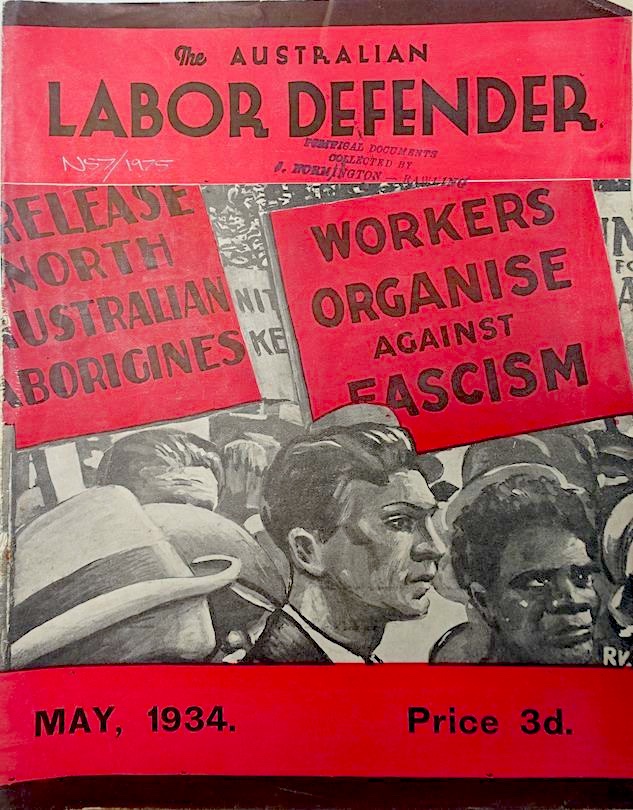
Throughout 1934, one campaign the MAWF took up with some success was to call for the release of Aboriginal prisoners captured during continuing armed skirmishes on Australia’s colonial frontier in the far north of the continent.5 This campaign gained the support of major trade unions and it was in this context that William Cooper, the AAL’s most senior member, decided that “the sun of the Aborigines was starting to rise” and the time was ripe to form an organisation.6 The AAL affiliated to the MAWF and spoke to meetings held by the movement over the coming year to rally support for their people.7
An Aboriginal Welcome for Egon Kisch
Aboriginal activists in Melbourne played a particularly prominent role in the visit of Egon Kisch, the Czech journalist and anti-fascist activist brought out to Australia to address a national MAWF conference in November 1934.8 Kisch was a communist from a Jewish family who had been arrested and expelled from Germany by the Nazis following the Reichstag fire. Kisch did not make it to the conference, due to efforts of the Australian government to block his arrival using the Immigration Restriction Act. Refused permission to alight from his ship, Kisch famously leapt from the deck and broke his leg, then spent almost two weeks in detention, before action in the High Court won his freedom. He toured the country drawing huge crowds, speaking of the dangers of fascism and the need to build working-class solidarity.
A staunch internationalist and anti-racist, Kisch sought out Aboriginal people everywhere he went in Australia and attended meetings with AAL spokespeople in Melbourne.9 His book on the tour, Australian Landfall, provides a moving account of a torchlit procession, attended by 10,000 people in Melbourne on 27 February 1935 to mark the second anniversary of the Reichstag fire.
Aboriginal people marched with Kisch at the head of this demonstration. One detailed tableau prepared for the night featured both Aboriginal people in chains and prisoners being executed by Nazis in Germany.10 Whereas the Australian government had tried to bar Kisch’s entry, the original owners of the continent gave him a formal ceremonial welcome. As Kisch recalled:
“The Aborigines present our man with a war-boomerang, heirloom of their tribe, a real damascened sword made of wood. The gift signifies: Come back, like a boomerang, come back!”11
The spirit of this powerful act of Aboriginal solidarity with a Jewish anti-fascist persecuted by racist immigration laws has been present throughout history and is very much alive today. Other notable examples include a protest by the AAL at the German Consulate in Melbourne in 1938 in the wake of Kristallnacht12 and special ceremonies conducted by Aboriginal Elder Ray Jackson in the 2010s, issuing specially designed “Aboriginal passports” in response to the Australian government’s vicious regime mandatory detention of asylum seekers.13 The specific details of the February 1935 demonstration are not often well understood and should be popularised to inspire continuing struggle. The uncompromising position of unceded sovereignty advanced by Aboriginal activists both then and today, however, has had a dynamic impact on broader movements challenging both the legitimacy of fascist assertions that Australia should be a “white” nation and the racism of mainstream politics that is creating space for fascists to grow.
To cite this article:
Padraic Gibson, ‘Aboriginal Leadership and Anti-fascist Protest in Australia,’ The Helsinki Notebooks, Vol. 2, No. 4 (17 November 2025).
Aboriginal Leadership and Anti-fascist Protest in Australia © 2025 by Paddy Gibson is licensed under CC BY-NC-ND 4.0


- “Calls for inquiry into Camp Sovereignty attack,” ABC News, 2 September 2025. https://www.abc.net.au/news/2025-09-02/iat-camp-sovereignty-follow/105722830 ↩︎
- Blak Caucus @blakcaucus, “National Day of Action – Sovereignty Never Ceded,” Instagram, 8 September 2025. https://www.instagram.com/p/DOVbCl7kpvc/?img_index=1 ↩︎
- Gary Foley, “Australia and the Holocaust: A Koori Perspective,” in The Power of Whiteness and Other Essays, Aboriginal studies occasional paper (1) (Melbourne: Centre for Indigenous Education, University of Melbourne, 1999), 74-87. ↩︎
- L. Sharkey, “The Fight Against Fascist Ideas,” Workers’ Weekly, 9 March 1934, 3. ↩︎
- Padraic Gibson, “Egon Kisch and Black Australia”, in Evan Smith et al (eds), Histories of Fascism and Anti-Fascism in Australia, (Routledge, 2022), 68-69. ↩︎
- William Cooper, “To the Minister for the Interior, Thomas Patterson, 31 October 1936,” in Thinking Black: William Cooper and the Australian Aborigines’ League, ed. Andrew Markus and Bain Attwood (Canberra: Aboriginal Studies Press, 2004), 54 ↩︎
- See for example, “Melbourne Women’s Anti-War Conference,” Workers’ Weekly, 21 June 1935, 3. ↩︎
- For a more detailed account of Kisch’s tour see Gibson, “Egon Kisch and Black Australia,” 61-79. ↩︎
- Egon Kisch, Australian Landfall (Melbourne: MacMillan, 1969), 173-194. ↩︎
- “Striking Tableaux for Kisch March – Aborigines in Chains”, News (Adelaide), February 21, 1935, 8. ↩︎
- Kisch, Australian Landfall, 136. ↩︎
- Foley, “Australia and the Holocaust: A Koori Perspective”, 74. ↩︎
- Joseph Pugliese, “Geopolitics of Aboriginal Sovereignty: Colonial Law as a Species of Excess of Its Own Authority, Aboriginal Passport Ceremonies and Asylum Seekers,” Law Text Culture 19 (2015), 84-115. ↩︎
Featured image: The front cover of the Australian Labor Defender in May 1934, a movement publication produced largely by the CPA. This cover features a sketch of a demonstration where you will see an Aboriginal figure present, with placards reading “Workers Fight Against Fascism” and “Release North Australian Aborigines”.


Leave a Reply