
“We remember – but we do not remember enough.”
–Georg Branting
After the Second World War, famous anti-fascist organizers and intellectuals grew increasingly concerned with the survival of what they saw as fascist regimes. As large parts of Europe had been liberated from fascism, they were outraged that the Franco dictatorship in Spain was allowed to persevere. To address this concern, they reorganized, in 1946, old anti-fascist solidarity committees that had once supported the republican cause during the Spanish Civil War. Georg Branting, quoted above, was one such personality. He was a left social democrat and the son of the former Swedish Prime Minister Hjalmar Branting. His calls to action did not simply entail a continuation of the anti-fascist struggle but also one of remembrance.
Branting feared that younger generations were growing up without fully understanding the catastrophe that fascism had brought to the continent. In response, post-war anti-fascism took on a mnemonic character as it then assisted in remembering the past, while attempts were made to create an anti-fascist collective identity built on the collective memories of those who had fought fascism. Spanish Committees were reorganized in Sweden, Denmark and Norway.
The committees in Sweden and Denmark were short lived, lacking the support of the social democratic parties. They were not willing to take up the Spanish Question, fearing that the issue would be instrumentalized and dominated by communists. In contrast, the Norwegian committee prospered, and a more leftist social democratic government engaged itself in foreign policy to prevent Spain from gaining access to international institutions such as the United Nations. This endeavor failed as Cold War tensions rose and the United States began to view Spain as an important anti-communist ally, culminating in its admittance to the UN in 1955.
Yet, the Norwegian anti-fascist sentiment persisted and contributed to Spain being kept out of NATO, where a full unanimity of members was required for the duration of the dictatorship. The Norwegian Spanish Committee was active for more than thirty years, providing economic support for the opposition and a large refugee population living in horrid conditions in France. It even organized vacations for Spanish refugee children to Norway, where they would rest and recuperate in the homes of Norwegian families.
When dealing with the Spanish Question, fascism was foremost conceptualized as an external threat. This would change during the early 1960s, with the so-called Swastika Epidemic. In the years 1959-1960, the world was outraged over acts of antisemitic vandalism at synagogues and Jewish cemeteries. In Sweden this was accompanied by attempts at neo-fascist and neo-Nazi recruiting campaigns in schools. As a response, a new sort of anti-fascist committee was organized in 1963: the Committee against Neo-fascism and Racial Prejudice (Kommittén mot nynazism och rasfördomar). Initially, it concentrated its work on educational campaigns about fascism, racism and the genocide of European Jews, to assist the younger generations in remembering.
Through its connection with the printer’s union, the Committee made sure that no printshop in Sweden would take orders from the Swedish neo-Nazi Nordic Reich Party. It sought broad political backing in the traditions of the Popular Front and succeeded to some extent, although it was always accused of being a communist front organization. It saw unchallenged racism as a potential breeding ground for future fascism and participated in a growing Roma civil rights movement.
Nevertheless, the main threat of fascism was still defined as external. Specifically, two European states, Spain and Portugal, were seen as examples of actual existing fascist regimes, and Greece was in the danger of becoming one. The bloody Portuguese Colonial War (1961-1974) brought attention to the Salazar dictatorship, otherwise often portrayed as largely benign. Colonial atrocities also brought attention to the white supremacist regimes of South Africa and Rhodesia. These issues, and more, were dealt with in texts published by the committee that sought to mobilize and revitalize anti-fascist engagement.
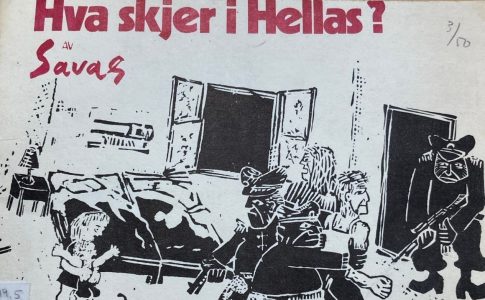
In 1963, the murder of the peace activist Grigoris Lambrakis in Greece brought renewed attention to the level of repression experienced by the Left in the country. The fear was that the fragile democracy was descending into fascism. In the minds of anti-fascists, this came true in 1967, although as a shock, as a military dictatorship took power in the country just months before elections were set to take place. Europe now had three fascist regimes and, once again, anti-fascists in the Nordic countries organized themselves into committees to resist and offer solidarity with those affected.

Even in Iceland, a committee was founded with the assistance of Greek diaspora activists from Sweden. Among them was a young Theodor Kallifatides., who was in Reykjavik in 1968 to participate in demonstrations against the NATO ministerial meeting.
In Sweden, the left social democrat Hans Göran Franck spoke directly to the need of these kinds of committees. Despite being the chairman of the Swedish chapter of Amnesty, Franck argued it was not enough to concern oneself about human rights violations. Greece had to be liberated from fascism, lest Western Europe wanted to repeat its betrayal of Republican Spain.
Danish social democrats, like Mogens Camre, had already well-established contacts to Greek political figures such as Andreas Papanderou. Since there was no large uprising against the regime, much of the initial work was about building international pressure on the regime to free Papandreou and the other politicians imprisoned by the Junta.
Thus, the committees organized a parliamentary fact-finding mission with MPs from all the Nordic countries except for Iceland. Norwegian politicians such as Otto Lyng and Aase Lionæs, who had themselves experienced Nazi occupation, argued with Junta officials until they were allowed to meet with prisoners. Back home the report of the delegation added to the public pressure on the Nordic governments to act against the regime, which they did in September 1967, when Sweden, Denmark and Norway filed applications for the expulsion of Greece from the Council of Europe to the European Commission on Human Rights.
The process dragged on for two years and the Nordic committees cooperated with legal teams to bring witnesses and testimonies of torture. Finally in 1969 Greece left the Council of Europe, when they realized there was a majority against them. It was seen as a huge victory movement and many hoped that this would open the path for further action within NATO. This failed as the United States would make sure the issue was not raised within the alliance.
The Nixon administration had a friendly relationship with the Junta and prioritized military interests over defending democracy. To break the deadlock, the Norwegian committee came up with a plan to unite the Greek opposition to present to the world a reliable democratic alternative to the Junta. Much effort was made but the initiative failed to bridge the deep disunity within the opposition.
The Norwegians had remembered how they had united against Nazi occupation and during postwar reconstruction. This anti-fascist collective memory informed them on how to best overcome a fascist dictatorship. The Greeks on the other hand, especially the conservatives, had their own memory of the Greek Civil War and for them it was unthinkable to unite with communists, even against the Junta. Ultimately, the Junta fell because of the Turkish invasion of Cyprus in 1974, when the Turks refused to negotiate a ceasefire with the regime forcing a return to democracy.
The history of the Nordic Committees for Democracy in Greece is a fascinating, often forgotten, chapter of postwar anti-fascist engagement. The importance of collective memory to the formation of anti-fascist identity was clearly illustrated as Swedish activists drew on the lessons of the Spanish Civil War, and Danes and Norwegians remembered their own liberation struggle against Nazi occupation. The Finns also remembered how close they had been to experiencing something very similar in 1932 during the failed Mäntsälä rebellion.
By 1975, the three Southern European dictatorships had fallen and were moving towards democratization. Fascism became once more a domestic concern, just as, in the same year, the Norwegian Maoist Party (Arbeidernes Kommunistparti AKP ml) organized a new committee to oppose the neo-Nazi party Norsk-Front. The committee published a magazine called Never again (Aldri mer), lobbied the government for a ban of the Nazis and violently broke up their meetings. This initiative became a precursor for a new wave of anti-fascist movements, although these were often inspired by anarchism and autonomism, which would resist neo-Nazism during the 1980s and 1990s in Sweden and Denmark.
References:
Georg Branting, Bryt med Franco (Stockholm: Arbetarnas Tryckeri, 1947), 4. From the original Swedish: “vi minns – men minns icke tillräckligt!”
Pontus Järvstad, Postwar Mnemonic Anti-Fascism: From the Spanish Question to the Nordic Committees against the Greek Junta, 1946–1974 (Oxon: Routledge, 2026).
Pontus Järvstad, “The Committee against Neofascism and Racial Prejudices: Nordic Anti-Fascist Organizing and International Solidarity in the 1960s,” in Anti-Fascism in European History: From the 1920s to Today, ed. Jože Pirjevec, Egon Pelikan and Sabrina P. Ramet (Budapest: Central European University Press, 2023), 123–141.
To cite this article:
Pontus Järvstad, ‘Postwar Mnemonic Anti-fascism 1946–1975: How Nordic “Committees” Organized a Continuity of Resistance and Remembrance,’ The Helsinki Notebooks, Vol. 2, No. 9 (17 February 2026).
Postwar Mnemonic Anti-fascism 1946–1975: How Nordic “Committees” Organized a Continuity of Resistance and Remembrance © 2026 by Pontus Järvstad is licensed under CC BY-NC-ND 4.0





Leave a Reply