
Introduction: From Paradise to Haunting Monument
The Chagossians are a Creole people whose belonging and identity were once anchored in the Chagos Archipelago, shaped by the rhythms of a gentle communal life and tied to the palms planted by their ancestors. In the mid-20th century, this unhurried way of life was upended by the lethality of the British Empire: an impersonal bureaucratic machinery that (re)classified human lives as biological obstacles, inconveniences, “unpeople”, at will. The Empire exposed them to what Achille Mbembe described as “necropolitics” – a state of death, abandonment, and social extinction –, with the British colonial administration in the Indian Ocean sacrificing their entire ‘life-world’ to Anglo-American interests. It replaced this ‘life-world’ with a lasting “death-world” instead – a form of social existence where vast populations are subjected to conditions that confer upon them the status of the living dead.1
The Anglo-American Vision
The Chagos is an archipelago in the Indian Ocean. It was uninhabited until the late eighteenth century, when France established it as a coconut plantation site incorporated into the plantation economy of its main colony, Île de France (now Mauritius), using enslaved Africans to work the land. In 1814, following the Napoleonic Wars and the Treaty of Paris,2 France ceded Mauritius to Britain, and with it, the Chagos, which thereafter continued to be administered as part of the Mauritian colony.
In 1835, slavery was abolished in Mauritius, and therefore in its outer islands, including the Chagos. Indentured labour was immediately imported to sustain the archipelago. There, a stable Creole population grew over the next century, functioning peacefully and relatively autonomously, with its own social institutions, cultural practices and ecological knowledge rooted in effortless continuity. This population sustained itself through fishing, coconut cultivation, and dense intergenerational networks of kinship and gentle belonging.
In the 1960s, Cold War anxieties intensified and strategic planners viewed the archipelago, particularly its largest atoll Diego Garcia, as an ideal military platform: it was at the centre of the Indian Ocean’s major maritime routes linking Africa, the Middle East and Asia; it was also isolated, offering low vulnerability to attack; and its proximity to chokepoints like the Persian oil routes enabled surveillance and logistical support. However, an existing population would attract the scrutiny of UN decolonisation norms – specifically Resolution 1514 (XV) of 19603 – and eventually prevent the development of this platform. Therefore, there had to be no population at all, meaning Chagossians had to be removed from the archipelago.
Creating the Chagossian “Unpeople”
A first step toward this removal came through negotiations preceding Mauritian independence in 1968, through which Britain and the colonial government of Mauritius agreed to no longer treat the Chagos as Chagossian homeland but to detach it from Mauritius and annex it to Britain as a strategic asset from 1965. In exchange, Britain compensated Mauritius financially and supported its transition to sovereign statehood. This negotiated detachment created the British Indian Ocean Territory.4
Next, the British colonial administration reclassified the Chagos as terra nullius: a land belonging to, and populated by, no one. This meant the fabrication of a legal void whereby the Chagossians were stripped of their status as people and therefore as inhabitants, reduced to mere biological entities positioned outside the protections and guarantees normally attached to legal personhood. This judicial downgrading was made possible through linguistic degradation as evident in the 1960s Internal British Colonial Office memos describing the inhabitants as “some few Tarzans or Men Fridays whose origins are obscure.”5
This reclassification quickly escalated from legal fiction to overt terror intended to break the spirit of the Chagossian population. This is seen in the mass killing of Chagossian pet dogs ordered by Sir Bruce Greatbatch, the colonial governor at the time. Colonial officers rounded up the dogs, sealed them in copra-drying sheds, and gassed them with vehicle exhaust while their owners were forced to watch.6 For Chagossians, these dogs were not just pets but members of the household, integral to daily life. Forcing them to witness how easily “disposable” their dogs were to the British underscored their own vulnerability within the colonial order. As Mbembe explained, sovereign power is defined by the capacity to dictate who is “disposable”. At that moment, the British colonial administration made that hierarchy clear: they decided who lived and who died.
The British tightened their stranglehold further, engineering a slow but steady suffocation of life on the islands. They drastically reduced food and supply shipments from Mauritius, undermined traditional fishing and self-sustenance, and made medical care unreliable while barring return after off-island treatment. Chronic deprivation escalated vulnerability to starvation and illness, turning daily life into a struggle for survival embodying Mbembe’s “death-world” of imposed abandonment. For Chagossians, departure from the archipelago became the only escape, allowing the British to frame removal as voluntary or consensual relocation.
Diaspora and Social Death
The “death-world” did not end at the Chagossian shorelines. It continued across the Indian Ocean, in Mauritius, where Chagossians were disembarked between 1965 and 1973 into the slums of the capital, Port Louis, without legal status, preparation, protection, adequate housing, employment or infrastructure.
In Port Louis, displacement gave way to social liquidation, a form of bloodless death in the sense that Chagossians were neither recognised as citizens of Britain despite the Chagos annexation nor treated as refugees to be integrated into Mauritian society. They were suspended instead between categories, occupying a space of civic abandonment, given the right to live but not the means to exist. They were reduced to invisible, disposable urban waste churning in tin shacks and overcrowded rooms, begging to go back home. The land, sea, and kinship networks that had sustained them for generations were gone.
The ontological extension of their displacement, from a gentle, self-reliant island life to predatory claustrophobic poverty in the peripheries of Port-Louis was the final colonial coup de grâce against the Chagossian spirit. The resulting trauma, the profound lasagren (known in the Chagossian Creole tongue as a state of utmost sadness), manifested in generational depression and substance abuse as they became prisoners of a state of unbeing. They were physically alive but legally, socially and mentally extinct – the ultimate victory of necropolitical sovereignty.
The Modernised State of Exception
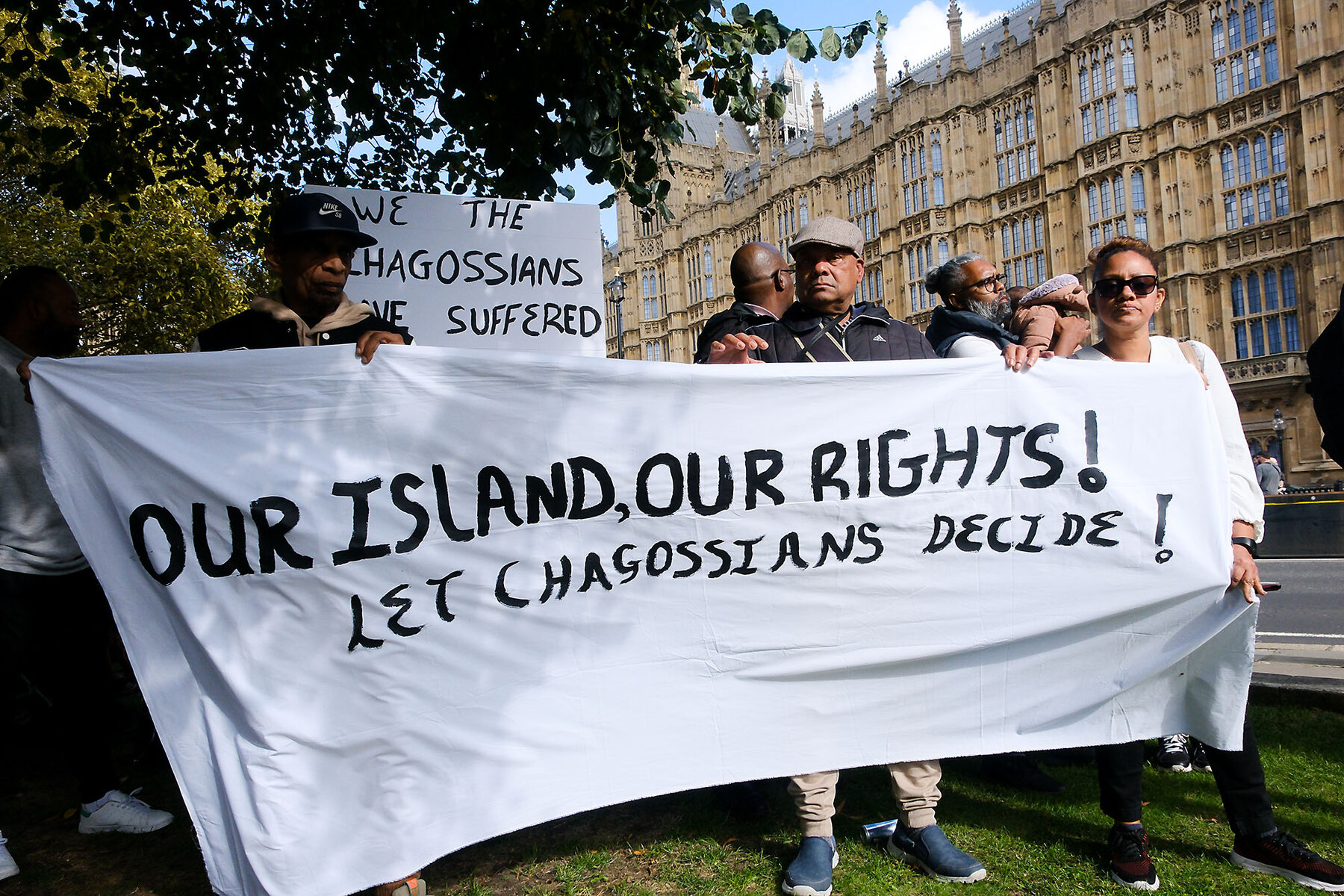
The past decade has seen a flurry of contestations over the Chagos. Chagossians who grew up in exile have successfully mobilised through cultural resistance, including singing,7 storytelling, and advocacy, to assert their right to return to the archipelago. Mauritius has argued that Britain’s 1965 annexation violated territorial integrity in decolonisation.8 The 2019 International Court of Justice (ICJ) Advisory Opinion and the International Tribunal for the Law of the Sea (ITLOS) have animated this claim within the halls of international law, ruling Britain’s continued administration of the Chagos unlawful.9 But none of these developments have brought the Chagossians closer to returning to their homeland.
Britain and Mauritius reached a political agreement in 2024, formalised by treaty in 2025.10 Its terms dictate that Britain must transfer sovereignty of the Chagos to Mauritius. It makes provision for significant annual payments to Mauritius and a Chagossian trust fund to compensate for Britain’s prior control of the archipelago. Ratification remains pending amid UK parliamentary delays, US discussions and geopolitical concerns. While the treaty allows Mauritius to pursue resettlement, it does not lay out a concrete plan for it and expresses this rather loosely instead, in permissive, avoidant terms: “Mauritius is free to…”.11 To date, Mauritius has shown little interest in the cause of Chagossians and has focused primarily on territorial integrity.
Moreover, Diego Garcia was leased to the US in 1966 for 50 years, with an extension for another 50 granted in 2016. It is now a US high security installation, making it a restricted zone regardless of whom it belongs to. Any civilian return to the atoll is therefore foreclosed, subordinated to the strategic priorities of Anglo-American defence planning. The other atolls lack the housing, schools, healthcare facilities, transport links, water systems, energy, communications, and functioning local economies required for viable resettlement. In this case, resettlement can only recreate the state of precarity Chagossians already endure in Mauritius, making their return undesirable.
Conclusion: Normalised Necropolitics
Violence of this kind, inflicted through the fabrication of legal voids, terror tactics, blockades, dehumanisation, and forced removal, has historically provoked great outrage when inflicted upon other populations elsewhere in the world, specifically white populations. In the case of Chagossians, however, who linger in diaspora as living-dead, their fate conditioned by Britain’s enduring necropolitical power in this supposed grand age of decolonisation, this violence has been absorbed into the language of law, diplomacy and administration. Their suffering remains concealed behind layers of bureaucracy. Apathy prevails. For those in the Indian Ocean, one explanation is hard to ignore: this time, the victims are Black.
- Achille Mbembe, “Necropolitics,” trans. Libby Meintjes, Public Culture 15, no. 1 (2003): 39-40. ↩︎
- Peter H. Sand, “The Chagos Archipelago Cases: Nature Conservation Between Human Rights and Power Politics,” in The Global Community Yearbook of International Law and Jurisprudence 2013, vol. 1, Oxford UP, 2014, p. 126. ↩︎
- UN Resolution 1514 (XV) of 1960 affirms independence for peoples and nations under colonial rule. Sand, “The Chagos Archipelago Cases,” pp. 126-28; see also David Vine, Island of Shame: The Secret History of the U.S. Military Base on Diego Garcia, Princeton UP, 2009, pp. 91-93. ↩︎
- The British Indian Ocean Territory Order 1965, Statutory Instrument No. 1920, Her Majesty’s Stationery Office, 1965, p. 1. ↩︎
- Denis Greenhill, “Minute regarding the British Indian Ocean Territory,” 24 Aug. 1966, FO 371/184523, Foreign Office Files, The National Archives, Kew. ↩︎
- Alice Engelhard, “Imperial Mobilities, Errantry, and the Displacement of the Chagos Islanders,” Review of International Studies (Cambridge University Press, 2026), https://doi.org/10.1017/S0260210525101034a. ↩︎
- See famous song “Peros Ver” by Ton Vie, which tells us that Chagossians have not forgotten their homeland and their right to it. ↩︎
- International Court of Justice, Legal Consequences of the Separation of the Chagos Archipelago from Mauritius in 1965 (Advisory Opinion), ICJ Reports 2019, p. 95. ↩︎
- For the foundational ruling on the unlawfulness of British administration, see Legal Consequences of the Separation of the Chagos Archipelago from Mauritius in 1965 (Advisory Opinion), ICJ Reports 2019, p. 95. This was subsequently affirmed in a maritime context by the International Tribunal for the Law of the Sea in Delimitation of the Maritime Boundary between Mauritius and Maldives in the Indian Ocean (Mauritius v. Maldives), Case No. 28, Judgment of 28 Jan. 2021. ↩︎
- Agreement between the Government of the United Kingdom of Great Britain and Northern Ireland and the Government of the Republic of Mauritius Concerning the Chagos Archipelago Including Diego Garcia, 22 May 2025, UK Treaty Series No. 1 (2025), CP 10273. ↩︎
- Olivier Bancoult (leader of the Chagos Refugees Group) and other activists have publicly critiqued the 2025 Treaty for exactly this reason: it secures a state’s border but leaves the people’s return as a secondary, unfunded possibility; see also Laura Jeffery and Rebecca Rotter, Chagossian Resettlement in Britain: Resisters, Complainers, Users, Manchester UP, 2019, pp. 210-12. ↩︎
To cite this article:
Yanee Dewoo, ‘Chagos: British Necropolitics in the Age of Decolonisation,’ The Helsinki Notebooks, Vol. 2, No. 10 (16 March 2026).
Chagos: British Necropolitics in the Age of Decolonisation © 2026 by Yanee Dewoo is licensed under CC BY-NC-ND 4.0


Feature Image:
Matthew Chattle/Cover Images/Reuters: Chagossians protest outside the Houses of Parliament in London, demanding a bigger say in their future: https://www.csmonitor.com/World/Africa/2024/1120/chagos-mauritius-united-kingdom-icj-return


Leave a Reply