
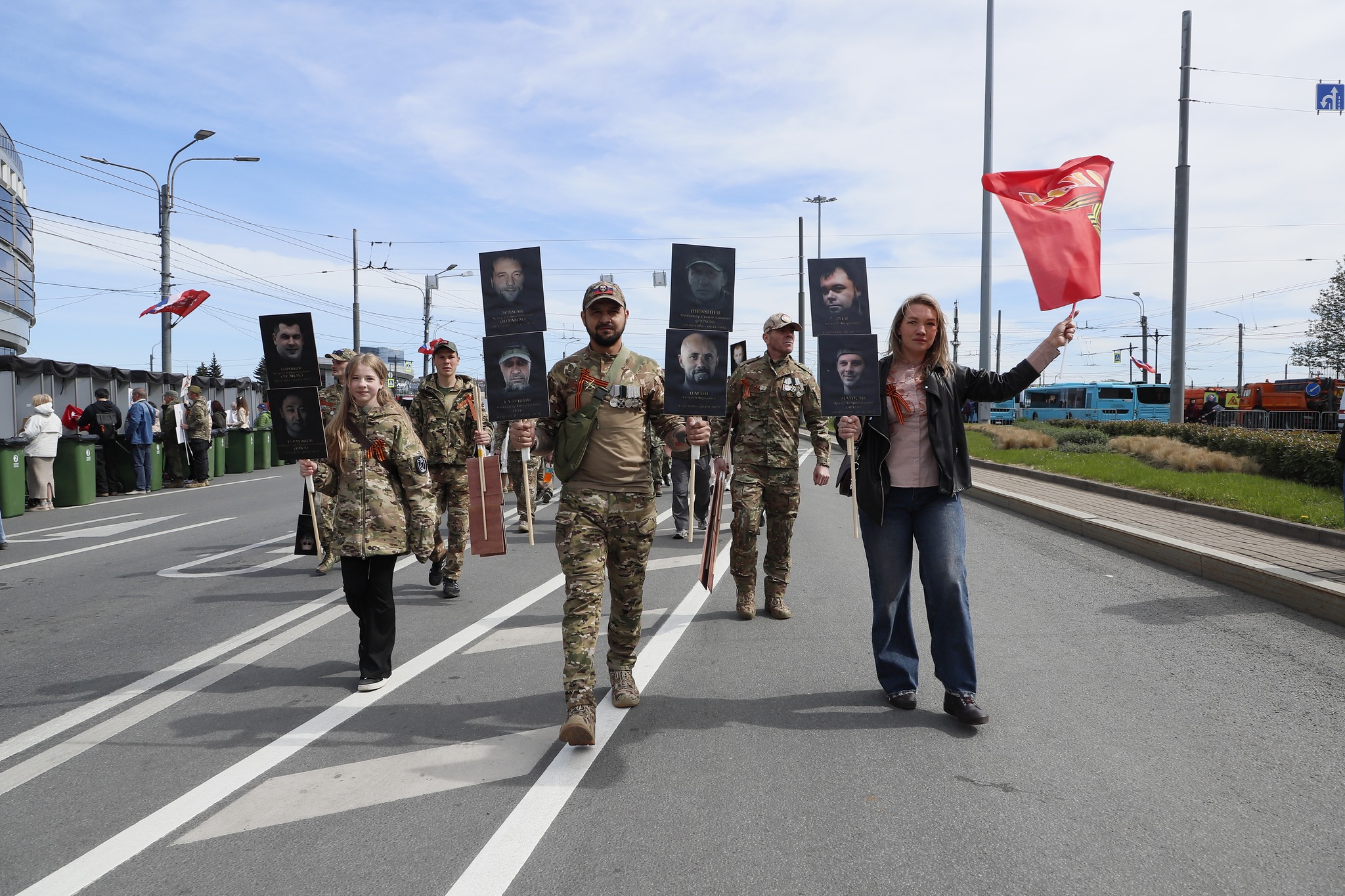
Since the Maidan uprising and Russia’s annexation of Crimea in 2014, Russian official discourse has consistently framed Ukraine through the language of “fascism” and/or “Nazism.” Ukrainian post-Maidan authorities have been called “neo-Nazis,”1 while the Russian-speaking population has been portrayed as victims of alleged persecution and even “genocide.”2 On 24 February 2022, Vladimir Putin justified the full-scale invasion of Ukraine as a mission to “demilitarize and denazify” the country.3 The same year, during a Victory Parade on Red Square, Putin explained that his “special military operation” is directed against “neo-Nazis and Banderites backed by the United States and their minions.”4
As scholars and journalists have demonstrated, these claims lack any empirical basis: there is no persecution (let alone genocide) against Russian speakers in Ukraine.5 And as stated in a collective letter by scholars of Genocide, Nazism and World War II, Ukraine “has right-wing extremists and violent xenophobic groups” like any country (their institutional presence remaining marginal, however), but “none of this justifies the Russian aggression and the gross mischaracterization of Ukraine.”6 One should also keep in mind that the president of Ukraine is a Russian-speaking Jew whose family members perished in the Holocaust.7
The task here, however, is not to restate this gap between the Russian propaganda and reality. Rather, it is to explain why the language of “antifascism” — and, more specifically, the memory of the Second World War — occupies such a central place in Russian representations of the war against Ukraine.
The use of the term “Great Patriotic War” to describe the period 1941–1945 is not merely a terminological issue. By excluding the years 1939–1941 (with the Molotov–Ribbentrop Pact, the joint invasion of Poland, and Soviet territorial expansion), the Soviet Union, and later Russia, positioned itself solely as the victim of Nazi aggression and the liberator of Europe. In other words, this chronology removes Soviet responsibility for the outbreak of the war and establishes a narrative of innocence and heroism which became the cornerstone of Soviet collective memory. Moreover, the Holocaust, as well as other particular experiences of war, were subsumed under the broader category of “Soviet suffering.”8
In post-war Soviet political language, “fascism” evolved into a flexible label. As reflected in propaganda, figures as diverse as Tito or Mao could be portrayed as “fascists.” Detached from its historically specific meaning, the term became a widely used moral category. As noted by Marlene Laruelle, it “belonged more to an emotional than to an analytical lexicon.”9
From the 1960s onwards, the memory of victory in 1945 became the central pillar of both Soviet legitimacy and specifically Russian national identity,10 replacing the legacy of the proletarian revolution and the fading promise of communism. Ritualized commemorations, sites of memory and everyday practices embedded the war into social life and identity.11
Under Vladimir Putin, the memory of the Great Patriotic War has been reactivated and instrumentalized in a new way. Rather than constructing a new ideology, Russian authorities have drawn on the already established myth of the 1945 victory.12 As scholars have noted, history was transformed into a resource for state governance rather than an object of critical reflection.13 In other words, the purpose of this memory politics is not to commemorate the past but to legitimize political power in the present. For example, by emphasizing Stalin’s role in achieving victory while downplaying or justifying mass repression, the regime normalizes authoritarian governance. State violence and extreme forms of coercion are reframed as acceptable and even necessary instruments of collective survival.
Moreover, the glorification of the 1945 victory has allowed the regime to purge collective memory of the Soviet period of its specifically “socialist” elements. By retaining only the narrative of a “national” victory against an external enemy, the Soviet experience is recast as a story of national sacrifice and triumph. In this way, it becomes possible to integrate Tsarist Russia, the Soviet Union, and the Russian Federation into a single, continuous historical narrative.14
The narrative of the Great Patriotic War also serves as a disciplinary tool in Russia’s relations with neighboring states that Putin considers as Russia’s “legitimate” zone of influence. In December 2019, Putin organized a meeting with post-Soviet state leaders and selectively cited archival documents to justify Soviet actions in 1939–1940, including the partition of Poland and the annexation of the Baltic states.15 Similarly, symbolic practices (such as the installation of a giant screen on the Estonian border broadcasting Victory Day celebrations16) function as reminders to those who have “escaped” Russia’s sphere of influence. The Soviet victory is presented both as a source of moral superiority and as granting the right to reassert control over those once “liberated.” External observers often fail to grasp that often “we can repeat” (mozhem povtorit’), a widely circulating slogan in contemporary Russia, is not addressed to an abstract historical enemy, but to Russia’s contemporary western neighbors.
At the same time, Putin’s authorities have multiplied legal mechanisms to enforce this narrative. Since 2020, the Russian Constitution mandates “respect for the memory of the defenders of the Fatherland” and prohibits “diminishing the importance of the heroism” of the Soviet people.17 In 2021, legislation increased penalties for “insults” or “false claims” about the Second World War and its veterans.18 In April 2026, Vladimir Putin has signed a law making it a criminal offense to deny or approve what it describes as the Nazi “genocide of the Soviet people” during World War II or to insult the memory of “genocide victims.”19 Such interpretations are not grounded in any historiographical consensus.20 However, diverging from them is framed as betrayal and sanctioned accordingly.
As a result, the terms “fascism” and “Nazism” in contemporary Russian discourse no longer refer to historically defined ideologies and/or political regimes but become empty signifiers. They become interchangeable with notions of “enemy,” always designating the Other. This separation between the word and its historically specific meaning allows to simultaneously glorify the “antifascist” victory and promote exclusionary, xenophobic, ultraconservative policies without perceived contradiction. The logic is thus inverted: not “Nazi = enemy,” but “enemy = Nazi.”
Thus, the narrative of the Great Patriotic War provides a ready-made interpretive framework through which contemporary conflicts can be understood. Time is collapsed into a cyclical structure in which Russia is eternally engaged in a struggle against external enemies branded as “fascists.” This temporal fusion is particularly visible in practices such as the Immortal Regiment marches, where portraits of soldiers from the Second World War are increasingly replaced by portraits of soldiers who went to war against Ukraine and died there.21 Past and present are merged into a single, continuous, endless, existential war.
Similarly, the concept of “denazification,” invoked by Vladimir Putin on 24 February 2022, was detached from its historical meaning and repurposed to describe a war against a sovereign state whose political system bears no resemblance to Nazism. This semantic shift is the same as that outlined above: “denazification” rhetoric embeds the invasion of Ukraine within the moral universe of the Great Patriotic War. The Russian war against Ukraine is thus presented not as aggression but as a continuation of a historically sanctioned mission and as a defense against the eternal Enemies of Russia.22 It enables what Andreas Heinemann-Grüder describes as the “construction of legitimized violence,” whereby military action is framed as both morally necessary and historically justified.23 As recent analyses have shown, portraying Ukraine as a “Nazi state” (or a “Satanic regime,” a term aimed at those who favor the religious orthodoxy over the civic cult of the Great Patriotic War) facilitates the justification of extreme violence, calling for the destruction of Ukrainian statehood and society. What begins as a distortion of historical memory thus evolves into a discourse that legitimizes mass violence and normalizes incitation to genocide.24
This normalization is particularly visible through the case of an article “What Russia Should Do with Ukraine” by Timofey Sergeytsev published by RIA Novosti in April 2022.25 Published on the official state platform, this narrative reveals the true scope of “denazification.” There, “denazification” was described as a “total cleansing,” targeting not only alleged “Nazi leaders” but also “the popular masses who are passive Nazis,” deemed guilty of having supported the “Nazi government.” According to Sergeytsev, modern Ukraine is able to hide its Nazism behind aspirations for “independence” and “European development.” To destroy this Nazism, he argues, is to “de-Europeanise” Ukraine.
Indeed, one should pay attention to the expansion of this narrative beyond Ukraine. For instance, one could think of an article published on the official website of the Russian Foreign Intelligence Service, entitled “Eurofascism, Today as 80 Years Ago, Is a Common Enemy of Moscow and Washington.” The accompanying image depicts the body of a wild animal in the shape of a swastika with the face of the president of the European Commission, Ursula von der Leyen. With a European flag drawn on its stomach, the animal is caught between American and Russian/Soviet bayonets.26 In other words, the category of “fascism”, denoting an absolute evil that should be destroyed, is increasingly extended to include the European Union and, more broadly, the norms of international order that the European Union claims to defend.
Such representations reveal the ultimate emptiness of the “antifascist” vocabulary in contemporary Russian political discourse. Although the Trump administration includes figures openly associated with illiberal and far-right politics, and although it criminalizes antifascism as a form of left-wing extremism or even “terrorism,” the current American administration can nevertheless appear within the internal logic of Russian official discourse as “anti-fascist.” The logic is the following one: Trump’s administration is anti-European, while Europe is represented as Ukraine’s principal supporter and, consequently, as an enemy of Russia. Therefore, Europe is “fascist,” whereas actors hostile to it are incorporated into the symbolic camp of “anti-fascism,” regardless of their actual political orientation. In this way, both “fascism” and “anti-fascism” are stripped of any historical or ideological meaning and reduced to instruments of Russia’s informational warfare.
- http://www.kremlin.ru/events/president/news/20603 ↩︎
- https://www.bbc.com/russian/rolling_news/2014/09/140929_rn_skr_genocide_charges ↩︎
- https://en.kremlin.ru/events/president/news/67843 ↩︎
- http://en.kremlin.ru/events/president/news/68366 ↩︎
- https://theconversation.com/putins-claims-that-ukraine-is-committing-genocide-are-baseless-but-not-unprecedented-177511 ↩︎
- https://jewishjournal.com/news/worldwide/345515/statement-on-the-war-in-ukraine-by-scholars-of-genocide-nazism-and-world-war-ii/ ↩︎
- https://www.tandfonline.com/doi/full/10.1080/13518046.2022.2058179 ↩︎
- https://ridl.io/the-forgotten-holocaust/ ↩︎
- Marlene Laruelle, Is Russia Fascist: Unraveling Propaganda East and West (Cornell University Press, 2012), 30. ↩︎
- Geoffrey Hosking, “The Second World War and Russian National Consciousness,” Past & Present, no. 175 (2002): 162–87. ↩︎
- The Soviet Myth of World War II: Patriotic Memory and the Russian Question in the USSR, Studies in the Social and Cultural History of Modern Warfare (Cambridge: Cambridge University Press, 2021). ↩︎
- Laruelle, Is Russia Fascist: Unraveling Propaganda East and West, 43–61. ↩︎
- Jade McGlynn, Memory Makers: The Politics of the Past in Putin’s Russia (London; New York; Oxford; New Delhi; Sydney: Bloomsbury Academic, 2023). ↩︎
- https://www.aljazeera.com/opinions/2020/5/9/victory-day-and-russias-war-cult ↩︎
- https://www.theguardian.com/world/2019/dec/30/polish-pm-furious-at-putin-rewriting-history-of-second-world-war ↩︎
- https://bnn-news.com/russia-installs-large-propaganda-screen-aimed-at-narva-promenade-245521 ↩︎
- https://www.ponarseurasia.org/alarming-alterations-how-memory-politics-turned-the-russian-constitution-into-a-war-weapon/ ↩︎
- https://novayagazeta.ru/articles/2021/04/05/putin-podpisal-zakon-ob-ugolovnoi-otvetstvennosti-za-reabilitatsiiu-natsizma-i-oskorblenie-veteranov ↩︎
- https://meduza.io/en/news/2026/04/09/putin-signs-law-criminalizing-denial-of-nazi-genocide-of-soviet-people-during-world-war-ii ↩︎
- Konstantin Pakhaliuk, “Official Memory Politics, the ‘Genocide of the Soviet People,’ and the Distortion of the Holocaust in Modern Russia,” Holocaust Studies 0, no. 0 (n.d.): 1–24. ↩︎
- https://www.fontanka.ru/2026/05/09/76413070/ ↩︎
- https://eadaily.com/ru/news/2022/06/23/eksperty-specoperaciya-na-ukraine-eto-po-suti-prodolzhenie-velikoy-otechestvennoy ↩︎
- https://democratic-integrity.eu/memory-myth-and-militarisation/ ↩︎
- https://democratic-integrity.eu/kalikh-dzhibladze-incitement-to-genocide-against-ukrainians/ ↩︎
- https://holodomormuseum.org.ua/en/propaganda/the-article-by-propagandist-timofey-sergeytsev-what-russia-should-do-with-ukraine/ ↩︎
- https://meduza.io/en/feature/2025/04/19/imagined-common-enemies ↩︎
To cite this article:
Hanna Perekhoda, ‘The Weaponization of Antifascism: Russian WWII Memory in the War against Ukraine,’ The Helsinki Notebooks, Vol. 2, No. 14 (15 May 2026).
The Weaponization of Antifascism: Russian WWII Memory in the War against Ukraine © 2026 by Hanna Perekhoda is licensed under CC BY-NC-ND 4.0


Feature Image:
Image from one of the Immortal Regiment marches, where people in Russia carry portraits of family members who died at the front, both in WWII and in Russia’s war against Ukraine. Copyright Wasilisa Belkina.



Leave a Reply