
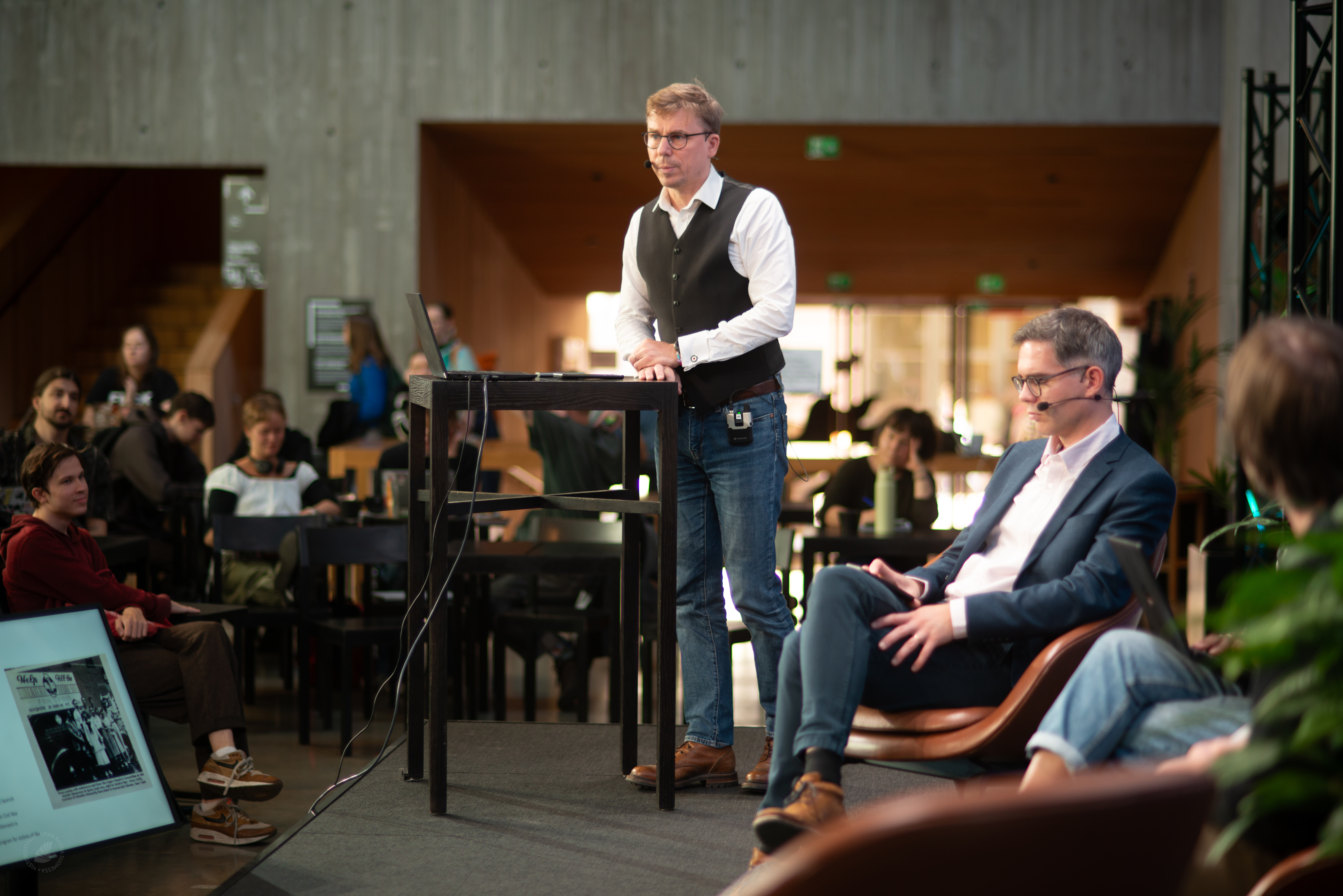
Event Date: Friday, 11 September 2026
Venue: Main Stage, Think Corner (Tiedekulma), University of Helsinki & Online
Organised by: Locating Global Protest project in collaboration with Historians without Borders in Finland
What do fascism and colonialism have to do with each other? Could they be understood not as separate histories, but as interconnected forms of power?
On 11 September, these questions brought one of the largest in-person and online audiences Tiedekulma has hosted to our public panel, Fascism as Colonialism? Colonialism as Fascism? Entanglements, Transfers, and Interpretations (1930s–1950s).

HISTORICAL TRAJECTORY
At the heart of the Locating Global Protest project is a commitment to recovering historical networks that connect anti-fascist, anti-racist, and anti-colonial struggles across national borders.
These connections were particularly evident between the 1930s and 1950s, when anti-colonial thinkers and activists across Africa, Asia, the Caribbean, and their diasporas challenged the notion that European fascism was an unprecedented anomaly. To those living under colonial rule, fascism looked disturbingly familiar, appearing as the domestic return and intensification of imperial violence, racial hierarchy, and gendered oppression.
Following the Second World War, however, mainstream academic historiography increasingly separated these interconnected histories. Fascism was reframed primarily as an internal European crisis, while colonialism was compartmentalised within area studies and imperial histories.
Over the past three decades, scholars have worked to restore these vital entanglements. However, much of this work has remained dispersed across specialised academic debates.
Our panel set out to bring these fragmented conversations together, returning to the earlier, integrated debate and opening it to wider public discussion.

PANEL CONTRIBUTIONS
The panellists examined this shared genealogy through distinct historical lenses, demonstrating that comparing fascism and colonialism does not mean treating them as identical, but rather uncovering their shared mechanics and global networks of resistance:
Kasper Braskén opened by mapping the intertwined histories of anti-fascism and anti-colonialism, highlighting how 1930s activists built transnational networks that treated opposition to imperial rule and European fascism as part of the same global struggle.
Moshumee Dewoo, in A Shared Genealogy: European Fascism and South African Colonial Statecraft, examined South Africa between the 1930s and 1950s. Drawing on anti-colonial thinkers, trade unionists, and political organisers, she demonstrated how local activists identified shared forms of racial statecraft across fascist and colonial regimes, situating European developments within a longer global history of white supremacy.
Shane Little, in Relating Colonialism and Anti-Black Fascism in the United States: The Case of Thyra J. Edwards, explored Black internationalism through Edwards’s activism. He showed how the rise of European fascism gave Black Americans a heightened vocabulary to articulate domestic racial oppression, while campaigns like Hands Off Ethiopia explicitly linked anti-fascism to anti-colonialism worldwide.
Oula Silvennoinen widened the scope to consider the broader historiographical and theoretical implications of connecting fascism and colonialism.
📺 Watch Recording (Presentations Only): https://youtu.be/goDroq7nJBo

AUDIENCE DIALOGUE
Fascism and colonialism are two of the most politically charged concepts in modern history. (Re-)Establishing the analytical link between them naturally prompted the room to confront contemporary global crises, testing these frameworks against international conflicts, modern state violence, territorial occupations, and political leaders.
These interventions underscored a crucial point: historical comparison is not about reducing modern regimes to simple labels, but about examining whether contemporary forms of state violence still rely on the imperial techniques and racialised logic formalised in the early 20th century. The audience’s appetite to apply historical rigour to modern political realities proved that these mid-century debates remain urgently relevant.

REFLECTING ON THE AFTERNOON
Beyond the exceptional turnout, the true success of the afternoon lay in what was created on the Tiedekulma stage: a space where academic research and public critique could meet without compromise. Our collaboration with Historians without Borders in Finland allowed the Locating Global Protest project to demonstrate that bringing these distinct histories into dialogue is a vital step toward understanding how global power and resistance continue to shape our present world.
We extend our deepest thanks to our co-organisers and everyone who joined the conversation, in person or remotely, for bringing thoughtful rigour to these questions and helping make the event a success.


Leave a Reply