
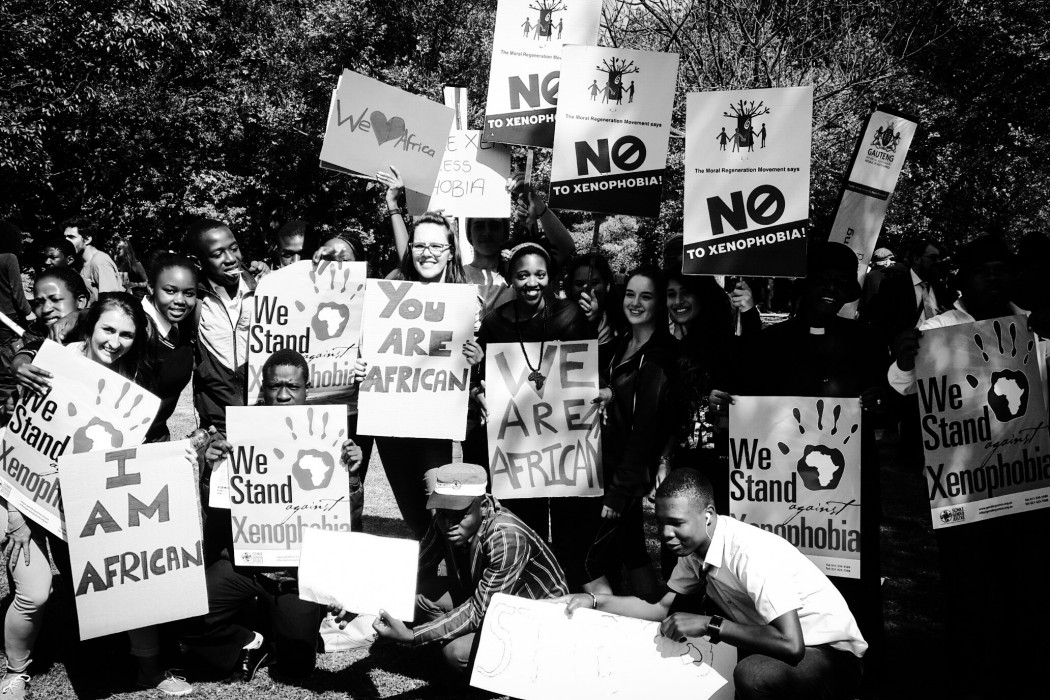
I am a ‘halfie.’
I am half Zimbabwean, half South African. I am neither one nor the other. I belong to both Zimbabwe and South Africa. I belong to neither one nor the other. I am caught in the middle of two broken people, two broken spaces. I claim both. I claim neither one nor the other. I cannot. For even if I wanted to, they do not claim me. This is where my fight against fascism begins – at the intersection of two nations that have both been scarred by colonial legacies and economic injustices, to pin ‘us’ against ‘them’, me against them, and them against me; to define ‘one’ from the ‘other’ for a hierarchisation of exclusionary societies.
The duality of my existence, my belonging to two nations, shapes my experience in a context where belonging is constantly contested, where the societal narratives that define, frame, or decide my identity mirror, in many ways, the broader fascist ideologies that pit citizens against migrants and sow seeds of division and mistrust among them. These ideologies are built on fear and rely on the construction of an ‘other’ in a weaponised false binary that invisibilises the complexities of identities into simple, simplistic, antagonistic categories. This dehumanises and ultimately marginalises migrants as much as it undermines the shared humanity that exists among all individuals, regardless of their origin.
I have experienced firsthand how the migrant community, especially from Zimbabwe, has been scapegoated for decades for the failures of the post-independence South African state. This is a manifestation of a fascist undercurrent fuelled by political rhetoric that frames migrants as threats to jobs and resources, as seen during the xenophobic violence in 2008, where foreign nationals were attacked, their homes looted, and many were killed, as well as in the 2015 attacks, where thousands of migrants were driven from their homes. This fascist undercurrent moves in the direction of forging a South African national identity at the expense of migrants.
Fascism is about exclusion; I am clear on this. And as someone with a dual identity, I represent a challenge to this exclusionary narrative. My existence defies the simplistic classifications that fascism thrives upon, illustrating that identity is complex and multifaceted. My fight against fascism is thus deeply personal since being a ‘halfie’ means grappling with the tensions of belonging – witnessing the pain and struggles of both South African and Zimbabwean communities, while facing the hostility directed toward migrants in a country that once wanted to be a post-apartheid, post-colonial rainbow nation. It is within this context that I advocate for solidarity among both communities rather than sitting still in the face of the cycles of division that historical injustices have established between them – injustices that reflect a deeper ideological battle that seeks to maintain power structures rooted in oppression.
Through my research on vulnerable female migrant navigation strategies within precarious zones at the department of Social Anthropology at the University of Cape Town, and my work as a digital activist for the Democracy Development Program (DDP), South Africa, an organisation that “aims to deepen the practice of democracy in South Africa”, I aim to challenge the political rhetoric that fuels hatred and division between the two nations by amplifying not only my own duality but the duality of those that are silenced. This is my way of confronting fascism and advocate for an inclusive South African society – whether this occurs through the targeting of migrants, the perpetuation of racial hierarchies, or the scapegoating of the vulnerable.
My fight begins with recognising that fascism is not just a historical term; it is a lived reality for many, including myself. As I navigate my dual identity, I am committed to challenging the ideologies that seek to divide us. It is a fight for recognition, for dignity, and for the right to belong – both to my roots and to the shared struggles of those around me. Together, we can dismantle the barriers erected by fascism, advocating for a society where everyone, regardless of their origin, is embraced and valued.
To cite this article:
Thelma Nyarhi, ‘A Halfie’s Fight Against Fascism,’ The Helsinki Notebooks, Vol. 1, No. 2 (1 Nov. 2024).
A Halfie’s Fight Against Fascism by Thelma Nyarhi is licensed under CC BY-NC-ND 4.0





Leave a Reply