
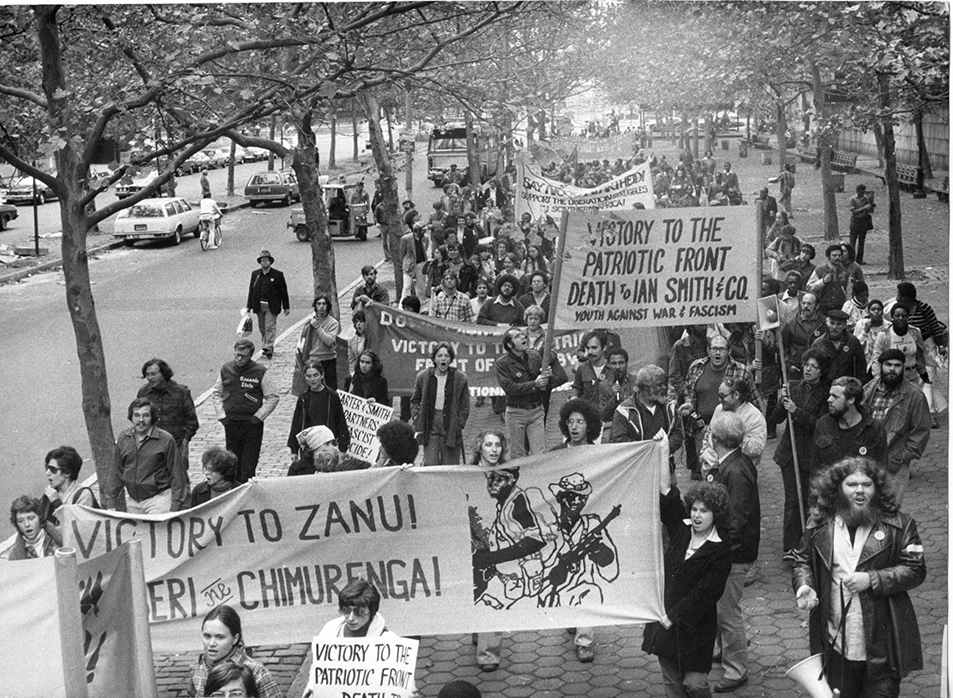
The history of colonial Zimbabwe is not merely a chronicle of stolen land and broken treaties but a searing testament to how power constructs itself through myth and erasure. In the mid-20th century, as Rhodesia’s white-minority regime clung to its racial fortress, African nationalists waged a war not only of bullets but of ideas. For the Zimbabwe African People’s Union (ZAPU) and the Zimbabwe African National Union (ZANU), the struggle against settler colonialism was inseparable from a global battle against fascism—a term they wielded with surgical precision to dismantle Rhodesia’s claims to legitimacy. Their intellectual and ideological arsenal, articulated through publications like Zimbabwe Review and Zimbabwe News, reframed the liberation struggle as part of a transnational anti-fascist front, drawing lines from the concentration camps of Nazi Germany to the “protected villages” of Rhodesia, and from the rhetoric of racial purity to the global resurgence of authoritarianism today.
When ZANU and ZAPU labelled Ian Smith’s regime as fascist, they were not indulging in hyperbole but constructing a political ontology. The swastikas splashed across their posters; the caricatures of Smith morphed into Hitler—these were provocations meant to rupture the settler state’s carefully curated image as a bastion of “Western civilisation.” The nationalists argued that Rhodesia’s foundations—racial capitalism, land dispossession, and a security apparatus designed to crush dissent—mirrored the core tenets of European fascism: the cult of racial superiority, the fetishisation of militarism, and the systematic dehumanisation of those deemed “outsiders.” In Zimbabwe News, writers dissected the Rhodesian Front’s hypocrisy: a government that lionised its role in defeating Nazism while replicating its methods. Black Zimbabweans were barred from voting, confined to labour reserves, and subjected to laws that criminalised their existence—a perverse mimicry of fascist apartheid. The settler state’s propaganda, which framed Black suffering as the “price of progress,” echoed Goebbels’ machinery of lies, twisting morality to justify plunder.
This rhetorical strategy was both tactical and epistemological. By aligning Rhodesia with the 20th century’s most reviled ideology, ZANU and ZAPU internationalised their struggle, appealing to a world still reckoning with the Holocaust. They exposed the global circuitry of white supremacy, linking Smith’s regime to apartheid South Africa, Portugal’s collapsing African colonies, and the tacit support of Western powers that prioritised Cold War alliances over human rights. But the analogy also served a deeper purpose: it forced a redefinition of fascism itself. For the nationalists, fascism was not an aberration confined to 1930s Europe but the logical endpoint of colonialism—a system that relied on perpetual violence to maintain racial hierarchies. Rhodesia’s “protected villages,” where over a million Africans were corralled into barbed-wire enclosures under military surveillance, were not merely counterinsurgency tactics but colonial innovations in mass control. ZANU’s journalists documented families severed from ancestral lands, their movements policed, their labour extracted at gunpoint. These were not security measures, they argued, but experiments in social annihilation—a blueprint for how states could erase personhood under the guise of order.
The act of renaming the nation—from Rhodesia, a monument to imperialist Cecil Rhodes, to Zimbabwe, invoking the pre-colonial Shona kingdom—was a decolonial strike at the heart of settler mythology. It rejected the legitimacy of a state built on stolen sovereignty and reasserted an indigenous historical consciousness. This was more than symbolism; it was an ideological reclamation. The word “Zimbabwe” became a vessel for imagining a future unshackled from the racial capitalism that enriched white settlers while impoverishing the Black majority. In the pages of Zimbabwe Review and Zimbabwe News, contributors wove the 1970s Chimurenga (liberation war) into the lineage of the 1896-97 First Chimurenga uprising, framing resistance as an intergenerational covenant. The magazines functioned as insurgent archives, publishing Marxist critiques of empire, transcripts of guerrilla radio broadcasts, and manifestos that tied local struggles to revolutions in Vietnam, Algeria, and Angola. They were classrooms for the masses, dissecting how colonialism operated as a mode of production—extracting wealth from Black bodies to feed global capitalism—and how liberation required dismantling its economic scaffolding.
Crucially, ZANU and ZAPU’s anti-fascism was not a solitary endeavour but a node in a sprawling web of global solidarity. Independent African states like Zambia and Tanzania provided sanctuaries for guerrillas, while the Soviet Union and China supplied arms and ideological frameworks that framed the struggle as part of a worldwide socialist offensive. Scandinavian NGOs and Western anti-apartheid activists amplified the cause, organising boycotts and smuggling pamphlets into university campuses. This coalition reflected a shared understanding: Rhodesia was not an isolated tyranny but a local expression of transnational fascism. The nationalists’ use of Nazi imagery resonated with a generation that had witnessed the horrors of Auschwitz and now saw them reenacted in African villages. When ZAPU’s Zimbabwe Review juxtaposed photos of emaciated detainees with those of Holocaust survivors, it was a deliberate provocation—a demand that the world confront its complicity in settler violence.
The legacy of this rhetorical and ideological warfare reverberates today, as movements from Black Lives Matter to Palestinian liberation deploy the language of anti-fascism to challenge state violence. The nationalists’ insistence that fascism is not a historical relic but a structural condition—rooted in colonialism, racial capitalism, and militarism—offers a lens to dissect modern authoritarianism. When far-right leaders in Europe and the Americas vilify migrants, suppress voting rights, and glorify imperial pasts, they recycle the same ideologies that sustained Rhodesia. The resurgence of white supremacist terror groups, the militarisation of borders, and the corporate exploitation of the so-called Global South all echo the systems ZANU and ZAPU identified as fascist.
Yet, this lineage also compels critical questions. If anti-fascism is to remain a transformative praxis, it must expand beyond Eurocentric definitions. The Rhodesian case illustrates how fascism adapts to local contexts, masquerading as “development” or “security” while perpetuating exclusion. It challenges scholars and activists to confront the uncomfortable kinship between historical colonialism and modern authoritarianism—to see how the concentration camp, the ghetto, and the border wall are iterations of the same logic. Most urgently, it reminds us that anti-fascism is not a passive stance but a radical commitment to dismantling systems of dehumanisation wherever they fester.
The battle for Zimbabwe was never solely about replacing a white regime with a Black one. It was about incinerating the myth that oppression is immutable—that power, once entrenched, cannot be toppled. The nationalists’ pamphlets, posters, and broadcasts were weapons of imagination, crafting a vision of liberation that transcended borders. Today, as the far-right rallies and climate catastrophe exposes the violence of extractivism, their message endures: to resist fascism is to dare to dream of a world where justice is not negotiated but demanded, where liberation is not a relic of the past but a horizon we march toward, together.
To cite this article:
George Bishi, ‘Rhodesia’s Settler ‘Fascism’ and the Radical Imagination of Liberation: Reclaiming Anti-Colonial Resistance in the Shadow of Global White Supremacy’, The Helsinki Notebooks, Vol. 1, No. 8 (17 Feb. 2025).
Rhodesia’s Settler ‘Fascism’ and the Radical Imagination of Liberation: Reclaiming Anti-Colonial Resistance in the Shadow of Global White Supremacy by George Bishi is licensed under CC BY-NC-ND 4.0




Leave a Reply