
As T-Bone Slim, a Finnish American born Matti Valentin Huhta who wrote poems and songs, organized for the Industrial Workers of the World, and hoboed around America, once declared, “[w]herever you find injustice, the proper form of politeness is attack.”1 Alas, most people, who probably do recognize injustice when they see it, feel helpless, afraid, or uncertain about what to do.
The militant workers in the International Longshore & Warehouse Union (ILWU), by contrast, can boast of a long history of fighting fascism, imperialism, and racism. They have challenged these ideologies in multiple ways, but one favored tactic is to boycott cargo and ships from countries engaged in unjust wars or the oppression of their own people. Dockworkers in ILWU Local 10, the San Francisco Bay Area branch, have periodically engaged in such work stoppages since the 1930s and continuing into the 2020s.2
The ILWU emerged in the 1930s amidst a wave of progressive, even radical, labor and political organizing in the United States. This new union was led by and filled in the ranks with workers who embraced socialist tendencies including anarcho-syndicalism (T-Bone’s Wobblies) and communism. After winning their initial “Big Strike,” which shut down every Pacific Coast US port for six weeks in 1934, they gained control over the hiring process and instituted a “low man out” system in which union members, annually elected, dispatched other members who had worked the fewest hours—socialism in action. They also won raises, reduced hours, gained safer workplaces, and more. Over time, longshoremen who were previously considered “wharf rats” instead became the “lords of the docks.”3
One of the union’s core principles is fighting racism and other forms of discrimination, as laid out in the third of their Ten Guiding Principles:
Workers are indivisible. There can be no discrimination because of race, color, creed, national origin, religious or political belief, sex, gender preference, or sexual orientation. Any division among the workers can help no one but the employers. Discrimination of worker against worker is suicide. Discrimination is a weapon of the boss. Its entire history is proof that it has served no other purpose than to pit worker against worker to their own destruction.
Considering their values, it should not be a surprise that the ILWU has fought for their own members and oppressed peoples in distant lands.4
In the 1970s, Local 10 acted in solidarity with working-class Chileans fighting a military dictatorship. In 1973, General Augusto Pinochet—with the support of the CIA—overthrew the democratically elected socialist president Salvador Allende in a military coup d’etat. Subsequently, many thousands were killed, tens of thousands imprisoned and tortured, unions crushed, civil liberties trampled upon, and more. Hundreds of thousands fled into exile where they built a global movement to oppose Pinochet and Chilean fascism. Workers and unions in many countries declared their support for the resistance.5
The ILWU was one such union though, importantly, it had been involved in Chile prior to the coup. In 1972, the ILWU sent a delegation of dockworkers to meet their Chilean counterparts—part of a long-standing and ongoing effort to build personal connections with and learn from dockworkers around the world. Rank-and-file, working-class internationalism in action.6
Therefore in 1974, when the 4-masted Chilean sailing ship Esmeralda started a world tour hoping to whitewash the Pinochet regime, ILWU Local 10 members were educated and prepared. Thanks to Chilean comrades, people in the Bay Area knew that this ship had been used as a prison for Pinochet’s opponents during and after the coup. When the Esmeralda sailed into San Francisco Bay, protesters dropped a “Junta No” banner from the legendary Golden Gate Bridge. When it docked at Alameda Naval Air Station, hundreds of protesters had gathered to condemn the Pinochet regime.
The Chilean ship’s arrival also was opposed by COYOTE (Call Off Your Old Tired Ethics), a San Francisco sex workers’ union that announced their members would “boycott Chilean sailors”! One COYOTE leader, Margo St. James, declared, “[u]nion members [will] follow the example of [ancient Greek heroine] Lysistrata who encouraged the women of Athens to abandon their husbands’ beds in an effort to end brutal violence.”7
Just as the sex workers used their labor power to oppose fascism, so too did Local 10 members who refused to unload this torture ship docked in the East Bay.
A few years later, in 1978, an alert member of Local 10 discovered that the U.S. planned to ship bombs and other military equipment to the Chilean air force from San Francisco. Led by ILWU Local 10 leader Herb Mills, longshore activists built a campaign to oppose this effort. They partnered with Chilean exiles in the Bay Area (who had founded a cultural center in Berkeley called La Peña), other unions, and people in the Bay Area’s large Latino community. Mills planned with others in Local 10 and the International’s office (based in SF) and then boldly announced they would refuse to load weapons intended for Chile. It must be noted that, in so doing, longshore workers risked sacrificing their wages to help people far from the Bay Area and who they never had met.
Due to Local 10’s actions—one part of a larger effort led by Chilean solidarity groups, unions and social justice organizations, and Congressional allies–President Jimmy Carter’s administration announced it would no longer provide any military assistance for Pinochet’s Chile. Local 10 had played a vital role in the effort to combat fascism overseas which had been facilitated by U.S. interventionism and military assistance. While this effort was a “win,” the U.S. continued providing a huge amount of economic and military aid to other countries that declared themselves anti-communist in the global Cold War.
Just two years later, in late 1980, longshoremen discovered that the United States again planned to secretly ship military supplies to a Latin American military regime via a San Francisco dock, this time to El Salvador. In this Central American country long under the grip of “Yankee imperialism,” a nasty civil war was exploding which was viewed by the newly elected President Ronald Reagan as a(nother) site in the Cold War where communism had to be resisted no matter what the devastating cost to the local population. In 1980, the military and its paramilitary gang partners had assassinated Archbishop Oscar Romero, murdered four American nuns, and begun mass killings in the countryside.
When Local 10 members learned that, once more, they were being tricked into supporting U.S. plans that would kill more peasants and workers, they refused. Building on existing networks among Salvadorans and other Latinos, Catholic and other religious groups opposed to fueling foreign wars, and unions, Herb Mills forged a coalition to refuse loading weapons in December 1980-January 1981. As a result, Local 10 never did ship weapons to the Salvadoran junta. However, Reagan chose to greatly escalate U.S. involvement in El Salvador which contributed to more than 80,000 Salvadorans being killed and several million more going into exile—many, ironically, to the United States.8
These examples demonstrate how workers can use their power—when organized on the job and educated—to act in solidarity with other people fighting fascism, imperialism, and white supremacy. Unfortunately, these efforts do not always succeed but, as T-Bone Slim so poetically declared, there really is no other choice of action.
*For those interested in reading more about ILWU Local 10’s campaigns in El Salvador and, to a lesser extent, Chile, during his retirement Herb Mills wrote a very lightly fictionalized novel that could be considered a memoir, Presente: A Dockworker Story.9
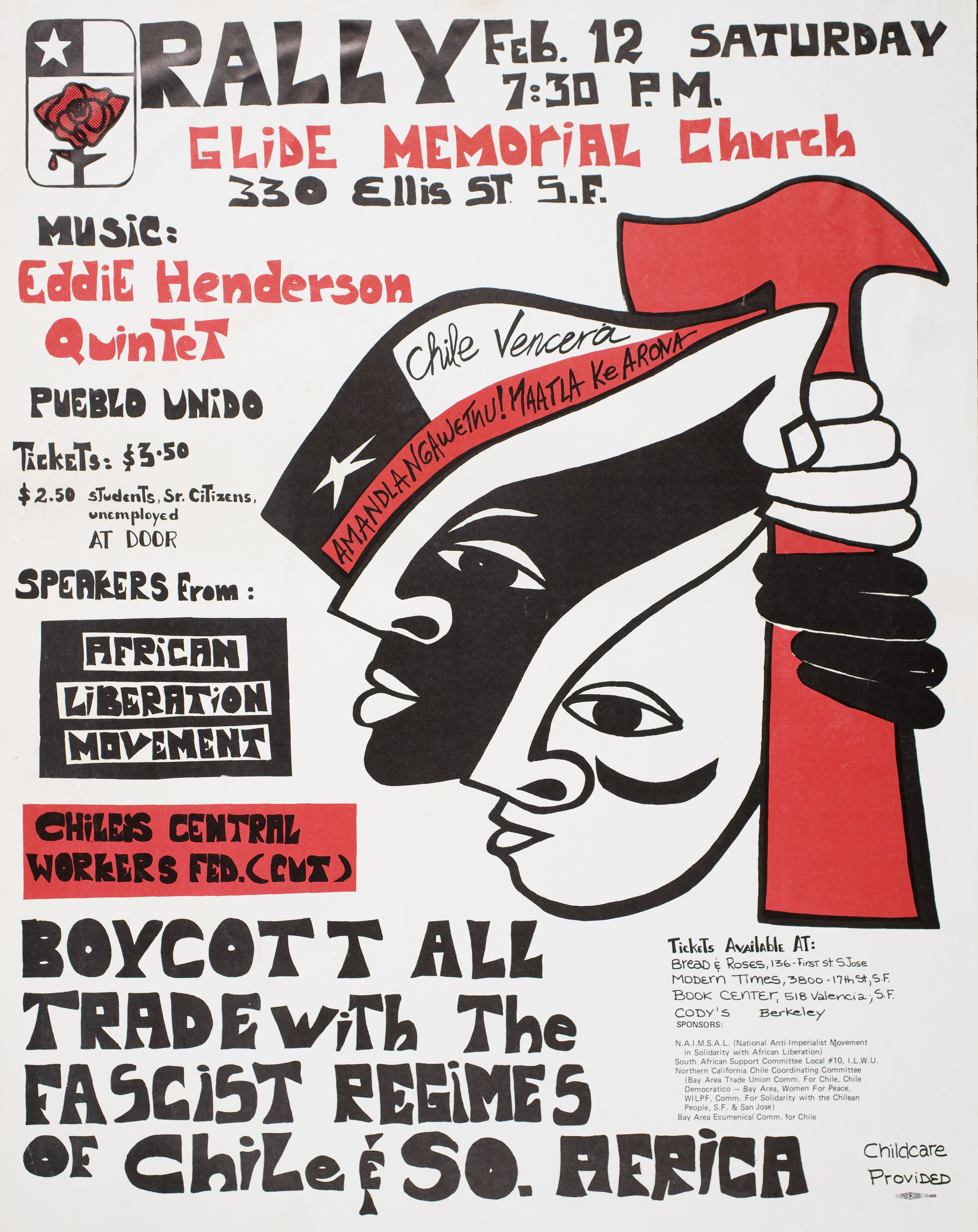
The featured image is a poster advertising a rally in 1977 at the Glide Memorial Church in San Francisco, CA, to ‘Boycott All Trade with the Fascist Regimes of Chile & South Africa’. Used by permission of Inkworks Press and Lincoln Cushing:
https://africanactivist.msu.edu/record/210-849-31968/
- T-Bone Slim, Juice Is Stranger Than Friction: Selected Writings Of T-Bone Slim, ed. by Franklin Rosemont (Chicago: Charles H. Kerr, 1993). ↩︎
- Peter Cole, Dockworker Power: Race and Activism in Durban and the San Francisco Bay Area (Urbana: University of Illinois Press, 2018), ch. 6; Peter Cole, “How American Dockworkers Fought Apartheid in South Africa,” Jacobin, November 24, 2024: https://jacobin.com/2024/11/ilwu-apartheid-south-africa-boycott ↩︎
- Bruce Nelson, Workers on the Waterfront: Seamen, Longshoremen, and Unionism in the 1930s (Urbana: University of Illinois Press, 1990); ILWU, “The ILWU Story”: https://www.ilwu.org/history/the-ilwu-story/ ↩︎
- ILWU, Ten Guiding Principles: https://www.ilwu.org/about/ten-guiding-principles/ and https://www.ilwu.org/wp-content/uploads/2012/07/R-18-Update-Article-III-of-the-10-Guiding-Principles.pdf. These principles have been periodically updated. For instance, at the union’s Thirty-fifth International Convention in 2012, a resolution was adopted which added “sex, gender preference, or sexual orientation to the Third Guiding Principle. Notably, in the 1950s the ILWU opened its ranks to members of the red-baited Marine Cooks & Stewards union which had a shockingly large and “out” number of LGTBQ members; Allan Bérubé, “No Red-Baiting! No Race-Baiting! No Queen-Baiting! The Marine Cooks and Stewards Union from the Depression to the Cold War,” in My Desire for History: Essays in Gay, Community, and Labor History, ed. by John D’Emilio and Estelle B. Freedman (Chapel Hill: University of North Carolina Press, 2011). ↩︎
- Julian Borger, “Fifty years on: The lasting tragedy of Chile’s coup,” The Guardian, 3 September 2023: https://www.theguardian.com/world/2023/sep/03/fifty-years-on-the-lasting-tragedy-of-chiles-coup ↩︎
- Peter Cole, “’Scrap Iron Becomes Bullets’: The dockers who fought fascism with solidarity,” Labor: Studies in Working-Class History 22:3(forthcoming in August 2025). ↩︎
- Heidi Tinsman, Buying into the Regime: Grapes and Consumption in Cold War Chile and the United States (Durham, NC: Duke University Press, 2014), 182-183. ↩︎
- “St. Óscar Romero,” Britannica: https://www.britannica.com/biography/Oscar-Arnulfo-Romero ;Hilary Goodfriend, “Óscar Romero Asked Jimmy Carter Not to Supply El Salvador’s Junta. Carter Didn’t Listen,” Jacobin, 24 March 2023: https://jacobin.com/2023/03/oscar-romero-el-salvador-junta-jimmy-carter-letter ↩︎
- Herb Mills, Presente: A Dockworker Story, ed. by Peter Cole and Matthew Tellon (New York: Hard Ball Press, 2024): https://hardballpress.squarespace.com/store/p/a-dockworker-story?inventory-product-preview=true ↩︎
To cite this article:
Peter Cole, ‘Remembering Dockworkers and their Fight Against Fascism,’ The Helsinki Notebooks, Vol. 1, No. 9 (3 Mar. 2025).
Remembering Dockworkers and their Fight Against Fascism by Peter Cole is licensed under CC BY-NC-ND 4.0




Leave a Reply