
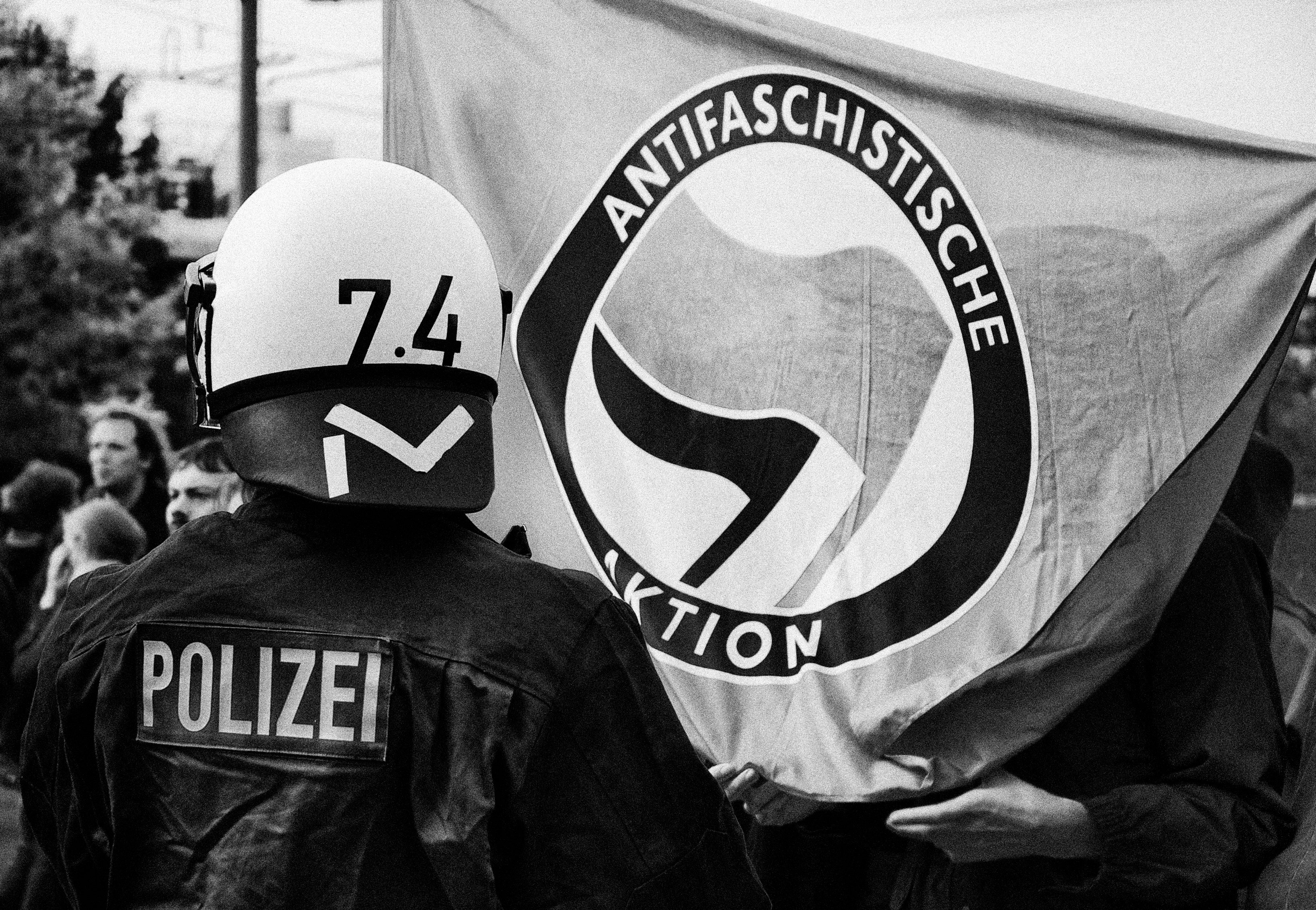
In response to the civil disobedience that erupted across US cities following the death of George Floyd on May 25, 2020, President Donald Trump defiantly asserted that, “it is essential that we protect the crown jewel of American democracy, the rule of law and our independent system of justice”.1 Despite his own anti-liberal views and stances, Trump invoked the language and political authority of liberal democracy to demonise and legitimatise the actions of the protesters. Anti-fascists, in particular, found themselves at the forefront of Trump’s attacks in his reading of the protests:
The violence and vandalism is being led by Antifa and other radical left-wing groups, who are terrorising the innocent, destroying jobs, hurting businesses and burning down buildings. – Radical left criminals, thugs and others all throughout our country and throughout the world will not be allowed to set communities ablaze. We won’t let it happen. It harms those who have the least. And we will be protecting those who have the least.2
How should anti-fascists navigate through the co-optation and weaponisation of liberal discourse against them by mainstream political actors like Donald Trump? My essay starts from an interest in understanding why it is so difficult for anti-fascist movements to gain broad public support and for people to identify themselves as anti-fascist. One explanation I want to explore lies in the concept of the “fascist creep”, where the lines between the radical right, fascism and liberal politics become blurred, and fascism gradually occupies a more normalised role in mainstream discourse.3 The power of the fascist creep resides in the ability of fascists to gain currency and influence to shape public opinion. Through exaggerated rhetoric, fascists direct negative emotions like fear and frustration to vilified and dehumanised outgroups – such as immigrants, sexual and ethnic minorities, or anti-fascists like Antifa – and frame them as scapegoats for wider societal problems.
I want to argue that anti-fascist resistance ought to be mindful in adapting their tactics to the current political environment – an environment in which creeping fascism is already a reality. The asymmetry in the ability to influence public discourse gives fascists an upper hand, highlighting the need for strategic anti-fascism. As Trump’s second sentence illustrates, fascism creeps by appropriating leftist politics such as social welfare and solidarity, emphasizing how “we will be protecting those who have the least”. This co-optation allows the fascist creep to go undetected, partly due to the popular understanding of fascism as a White European phenomenon from the inter-war era. By drawing on the language and logic of liberal democracy, fascism can present itself as the protector and champion of liberal democratic values, cleansing itself from its brutal and immoral history. The power of the fascist creep is similar to Hanna Arendt’s concept of the “banality of evil”: fascist actions do not provoke moral conflicts when people are merely following the rules and obligations of the surrounding society.4 Trump utilizes this tactic by adopting liberal discourse, which makes fascism appear banal and playing by the rules of liberal democracy.
Antifa operates outside of the traditional liberal framework, making it an easy target for Trump’s demonisation. Antifa’s political activism bypasses the use of the State and an appeal for the State’s protect. For example, providing community-led safety to groups under fascist-attack, rather than seeking police or state protection. Due to its decentralised structure, the group doesn’t have a clear representative, let alone access to mainstream media to defend itself. Without fair representation, Antifa can’t challenge misinformation or condemn inappropriate actions made by single members, which opens the door for political opponents like Trump to control the mythologised image of the Antifa terrorist.5 It is worth considering if certain tactics, such as inciting conflict at fascist gatherings, causing damage or major disruption in public spaces, or even criminal action, might turn out to be counterproductive. Unfortunately, these acts intended to make neighbourhoods safe spaces by eliminating fascists, can be framed in mainstream media as anti-democratic – opposing values like freedom of speech or the right to assemble – thus reinforcing the image of the threatening anti-fascists.
But what insights might anti-fascists gain from understanding the fascist creep in order to get their message across more effectively? Some have argued strongly that fascism is able to creep because neoliberal capitalism and growing corporate power have eroded public representation and agency and fascism has positioned itself as a viable alternative.6 In the end, the co-optation of liberal democratic language is only an empty ideal that fails to recognise how the promises of just and equal societies are not fulfilled. The negative emotions directed at outgroups are, among other things, the results of growing inequality, uncertainty and democracy deficit. The fascist creep can serve as a productive point of reflection: have anti-fascists “earned” the support of the people and been responsive to their basic needs, such as material security, well-being and recognition? Have they been clear enough, in the midst of political confusion, about their vision and their road to a just society, one in which the masses have a reason to participate? Anti-fascist action that responds to these root causes, like mutual aid groups organised by Antifa, are likely more difficult to be framed negatively in the media. Another example of similarly strategic anti-fascism, with a clear link to a vision of improved democracy and well-being, could be as Cox and Skidmore-Hess suggest, building mass-based civil society organisations that demand public accountability from the state and societal over corporate welfare.7
To combat the fascist creep and the imbalance in access to public discourse, anti-fascists must lean into community organizing instead of protests. By reaching people directly in the middle of political confusion, anti-fascists gain back control: they have the power to define who they exactly are and what they fight for. Even if people don’t want to identify as those “other” anti-fascists, it’s important to recognise how crucial it is for anti-fascists to have access to mainstream audiences in order to shape a political environment that is more responsive to anti-fascism.
- Fox News. (2020). Trump on escalating protests: Violence is being led by antifa, radical groups. youtube.com. From the website https://www.youtube.com/watch?v=bWQTv4v3aDI. ↩︎
- bid. ↩︎
- Ross, Alexander Reid. (2017). Against the Fascist Creep. AK Press. p. 2–3. ↩︎
- Villa, Dana. (2017). Eichmann in Jerusalem: Conscience, Normality, and the “Rule of Narrative”. The trial that never ends: Hannah Arendt’s Eichmann in Jerusalem in retrospect. Vol. 27. University of Toronto Press. p. 60–61. ↩︎
- Rilla, Jerónimo. (2024). What Kind of Group Is Antifa? New Political Science, 46(1), 81–100. p. 97–98. ↩︎
- Cox, Ronald W. & Skidmore-Hess, Daniel. (2022). How Neofascism Emerges from Neoliberal Capitalism. New Political Science, 44(4), 590–606. p. 590 ↩︎
- ibid. p. 605. ↩︎
To cite this article:
Sofia Kankaanpää, ‘Navigating the Fascist Creep: Strategic Anti-Fascism in an Era of Political Confusion,’ The Helsinki Notebooks, Vol. 1, No. 16 (1 July 2025).
Navigating the Fascist Creep: Strategic Anti-Fascism in an Era of Political Confusion © 2025 by Sofia Kankaanpää is licensed under CC BY-NC-ND 4.0


Featured image “antifa” by Gregor Fischer, CC BY-ND 2.0




Leave a Reply