
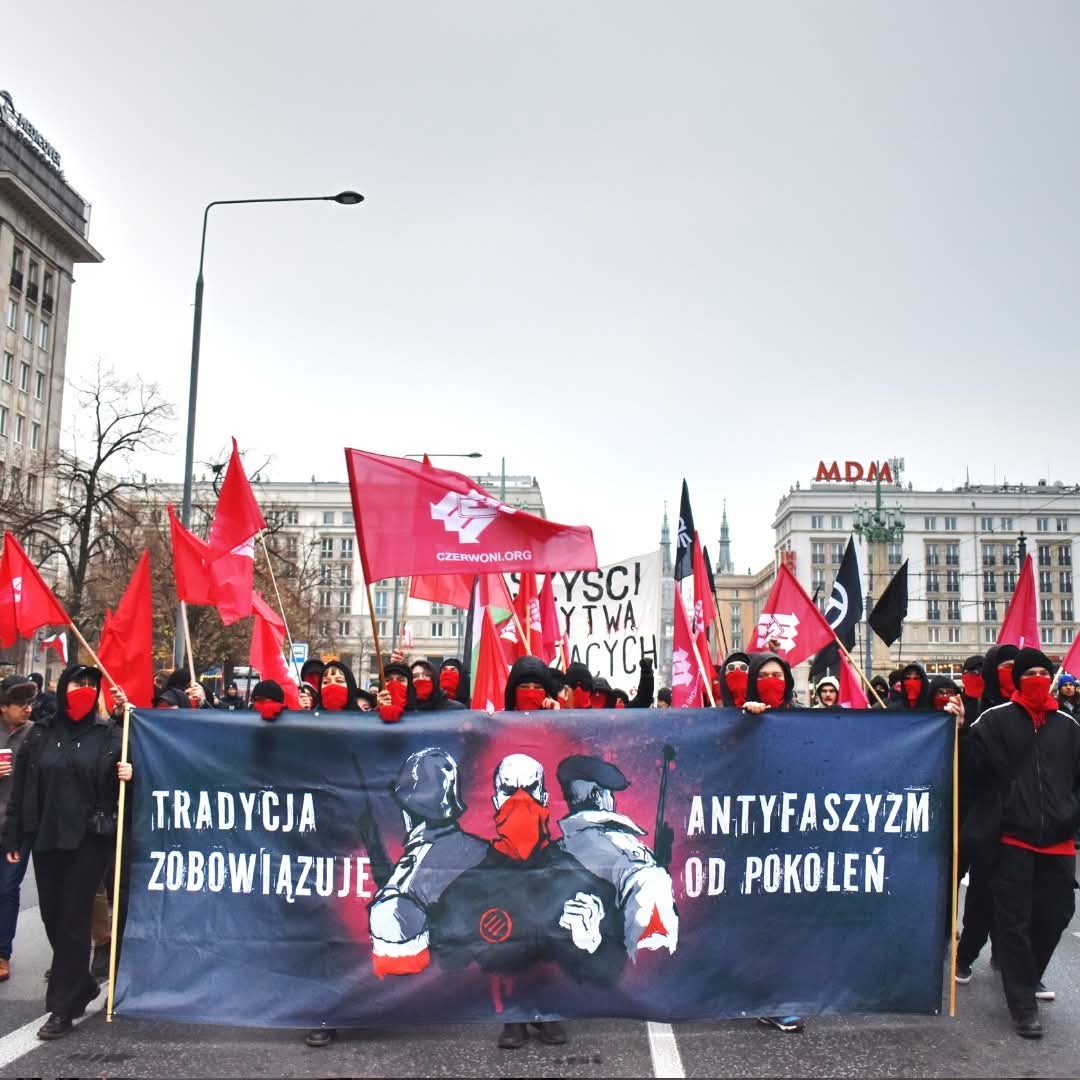
Between 1936 and 1939, thousands of foreign volunteers travelled to Spain to fight against fascism. Among them were nearly 5,000 Polish combatants who joined the 13th International Brigade. They were named the Dąbrowszczacy after the 19th-century revolutionary Jarosław Dąbrowski, and became symbols of internationalist solidarity and militant antifascism. Revered during the Polish People’s Republic (PRL), their legacy was institutionalized through school names, commemorative plaques, and even currency.
However, with the fall of communism in 1989, their reputation fell under scrutiny. In the post-socialist Polish state, the Dąbrowszczacy were reframed by dominant narratives as Soviet puppets, their antifascist struggle overshadowed by real or alleged communist affiliations. In recent years, their memory has become the subject of a fierce cultural and spatial tug-of-war—one that reveals deeper ideological currents in Poland’s shifting political landscape.
This essay explores how contemporary Polish antifascist movements—particularly the libertarian and radical left—are attempting to reclaim the memory of the Dąbrowszczacy. Through legal battles, symbolic spatial interventions, and performative actions, these activists resist state-led decommunization policies and challenge right-wing domination over public memory.
Decommunization and the Erasure of Antifascism
After 1989, decommunization in Poland unfolded as a protracted and often controversial process. Its early years focused on vetting former regime officials, but by the early 2000s, efforts intensified to purge communist-era symbols from public space. The 2016 decommunization law, passed under the Law and Justice (PiS) government, mandated the removal of street names, monuments, and references deemed to promote totalitarian ideologies.
The law created a wave of symbolic erasures, including attempts to rename streets honoring the Dąbrowszczacy. These measures reflect broader historical revisionism that presents Poland as the “victim of two totalitarianisms”—Nazism and communism—thereby excluding leftist anti-fascist traditions from national memory.
This shift also coincided with a decline in state-sponsored antifascist commemoration. As political scientist Tomasz Rawski has noted, commemorations of WWII’s end increasingly framed May 1945 as an exchange of one occupation for another, downplaying the antifascist victory narrative in favour of national martyrdom.1 The Dąbrowszczacy, once embedded in Poland’s official identity, became politically toxic.
A New Left Emerges: Fighting Erasure
Despite the conservative turn in national politics, particularly during the PiS years (2015–2023), Poland has also seen a resurgence of grassroots left-wing activism. This revival, driven by a new generation of intersectional and anti-authoritarian activists, marks a break from the post-communist left, which often struggled with its own ideological baggage.
What scholars have called “millennial activism” has played a significant role in rethinking antifascism. Rather than framing it strictly as anti-Nazism or pro-Soviet resistance, contemporary activists emphasize broader struggles for equality, human rights, and democracy. This reframing makes space for the Dąbrowszczacy—not as communist agents, but as early transnational antifascists fighting for a just cause.

Ironically, the rise of the far-right has amplified the need to reclaim such symbols. PiS and affiliated nationalist organizations offered legal and material support to ultraconservative groups like All-Polish Youth and the National-Radical Camp (ONR). These groups not only gained legitimacy but increasingly occupied public space—physically and discursively. Antifascist counter-movements responded by reclaiming visibility, not through grand narratives but via local, decentralized interventions.
Street names became a key battleground in the struggle over the Dąbrowszczacy’s legacy. Legal challenges were mounted in several cities, illustrating both institutional resistance and grassroots mobilization.
In Olsztyn, a 2018 attempt by the provincial governor to rename Dąbrowszczaków Street was overturned in court after local councilors argued that the Dąbrowszczacy were not exclusively communists. The administrative court ruled in favor of retaining the street name, underscoring the complexity of the brigade’s historical makeup. While, in Gdańsk, the situation was more contentious. When the governor renamed a street after Lech Kaczyński, activists from the Razem party, Social Justice Movement, and the Better Gdańsk Association organized public consultations. Although the Supreme Administrative Court upheld the governor’s decision, a 2024 local referendum showed significant support (25%) for restoring the original name—indicating a sustained public connection to the legacy.
The most high-profile case unfolded in Warsaw, where a grassroots initiative titled “Hands Off Dąbrowszczaków Street” mobilized public sentiment against the proposed name change. What began as a Facebook page evolved into a broader social campaign, culminating in a successful court appeal. In 2019, the name was restored after four years of legal wrangling.
Far from erasing the Dąbrowszczacy from public consciousness, these disputes reactivated interest in their story. For many activists, defending the street names became an entry point into antifascist organizing.
In the absence of institutional power, the radical left has long relied on symbolic practices to claim space. Graffiti, stickers, and murals are among the most visible—and subversive—tools in this repertoire.

A 2021 mural in Warsaw, painted on the wall of the anarchist squat Skłot Przychodnia, honored the 85th anniversary of the Spanish Civil War. It featured members of the 13th International Brigade and emphasized antifascist solidarity. The location—a stronghold of radical activism—was a deliberate choice, reinforcing the mural’s role as both a historical tribute and a declaration of presence.
Stickers serve a similar purpose. One design, produced by the “Hands Off” initiative, depicts Dąbrowszczacy fighters under the slogan “For Your Freedom and Ours.” Another, more cryptic sticker from the Red Youth of the Polish Socialist Party features only the International Brigade’s triangle emblem and the slogan “Eternal Glory to Those Fighting Fascism.” These visual interventions assert identity and resistance in urban landscapes often dominated by nationalist imagery.
Indeed, as sociologist Jan Kujawski observed, Poland saw an explosion of patriotic murals in the 2010s, particularly those celebrating the “Cursed Soldiers”—post-WWII anti-communist fighters, many of whom were linked to war crimes.2 In this context, leftist interventions like the Dąbrowszczacy mural offer counter-narratives that resist historical whitewashing.
Another vital tactic is what scholars call artivism—activism through artistic performance. In the Polish context, this strategy merges memory with protest, turning commemoration into a living, participatory act.
In 2024, the exhibition “If Madrid Falls, Warsaw Will Be Next” opened at the Warsaw Citadel Museum. Organized by libertarian-left activists, the exhibit showcased posters and documents linking Polish volunteers in Spain to broader antifascist legacies. Its placement in a mainstream cultural institution signified a rare moment of symbolic recognition for a narrative often confined to the margins.
Elsewhere, antifascist songs have been recontextualized for contemporary struggles. During the 2020 women’s protests against Poland’s near-total abortion ban, grassroots choirs in Kraków and Wrocław performed Bella Ciao—the Italian antifascist anthem. A Yiddish version briefly went viral before activists produced new Polish lyrics connecting reproductive rights to historical antifascism. These performances not only energized protestors but reinforced the idea that antifascism is not a closed chapter, but a continuing necessity.
Challenges and Strategic Silences
Despite their creativity and persistence, antifascist activists in Poland face formidable obstacles. Chief among them is the post-communist political climate, which remains deeply hostile to anything perceived as “leftist.” Many radical groups avoid explicitly left-wing labels, wary of being discredited as neo-communist or unpatriotic.
This reluctance has historical roots. The Polish anarchist scene of the 1980s—shaped by punk subcultures—was anti-authoritarian and strongly anti-communist. These values carried over into today’s libertarian movements, which often position themselves as “beyond left and right.”
Moreover, mainstream media frequently portray clashes between antifascists and neo-Nazis as subcultural skirmishes rather than political conflicts. This framing undermines the seriousness of antifascist action and delegitimizes its goals.
Reimagining the Antifascist Future
Reintegrating the Dąbrowszczacy into Poland’s collective memory is not merely an act of historical revisionism—it is a form of political struggle. In a country where the far-right increasingly monopolizes the narrative of patriotism, recovering alternative histories is both radical and necessary.
Symbols like the “three arrows” of the pre-WWII Iron Front—now commonly seen in Polish antifascist circles—serve as a bridge between past and present. They suggest that contemporary movements are not anomalies, but continuations of a longer tradition of resistance to tyranny and exclusion.
Yet for this tradition to thrive, it must find ways to disentangle itself from the shadows of authoritarian socialism. The challenge lies in preserving the universalist values of solidarity and justice that animated the Dąbrowszczacy, without replicating the dogmas of the past.
The story of the Dąbrowszczacy is more than a footnote in Polish history. It is a contested site where national identity, political memory, and spatial politics collide. Through courtrooms, street corners, and protest squares, today’s activists are reactivating this legacy—not as nostalgia, but as a living, breathing form of resistance.
In an era where historical revisionism threatens to flatten complexity and sanitize dissent, reclaiming antifascist memory is itself an act of courage. As the slogan of the Spanish Civil War reminds us: “¡No pasarán!” — They shall not pass.
- Rawski, T. (2019). The decline of antifascism: the memory struggle over may 1945 in the polish parliament (1995–2015). East European Politics and Societies, 33(4), 917-940. ↩︎
- ‘Murale patriotyczne w kontekście polityki historycznej’ in: R. Łatka (ed.) Studia z historii najnowszej, t. 4, Wydawnictwo IPN ↩︎
To cite this article:
Jan Bobrowski and Grzegorz Piotrowski, ‘Reclaiming the Dąbrowszczacy: Memory Battles and Antifascism in Post-Communist Poland,’ The Helsinki Notebooks, Vol. 1, No. 18 (4 August 2025).
Reclaiming the Dąbrowszczacy: Memory Battles and Antifascism in Post-Communist Poland © 2025 by Jan Bobrowski and Grzegorz Piotrowski is licensed under CC BY-NC-ND 4.0


Leave a Reply