
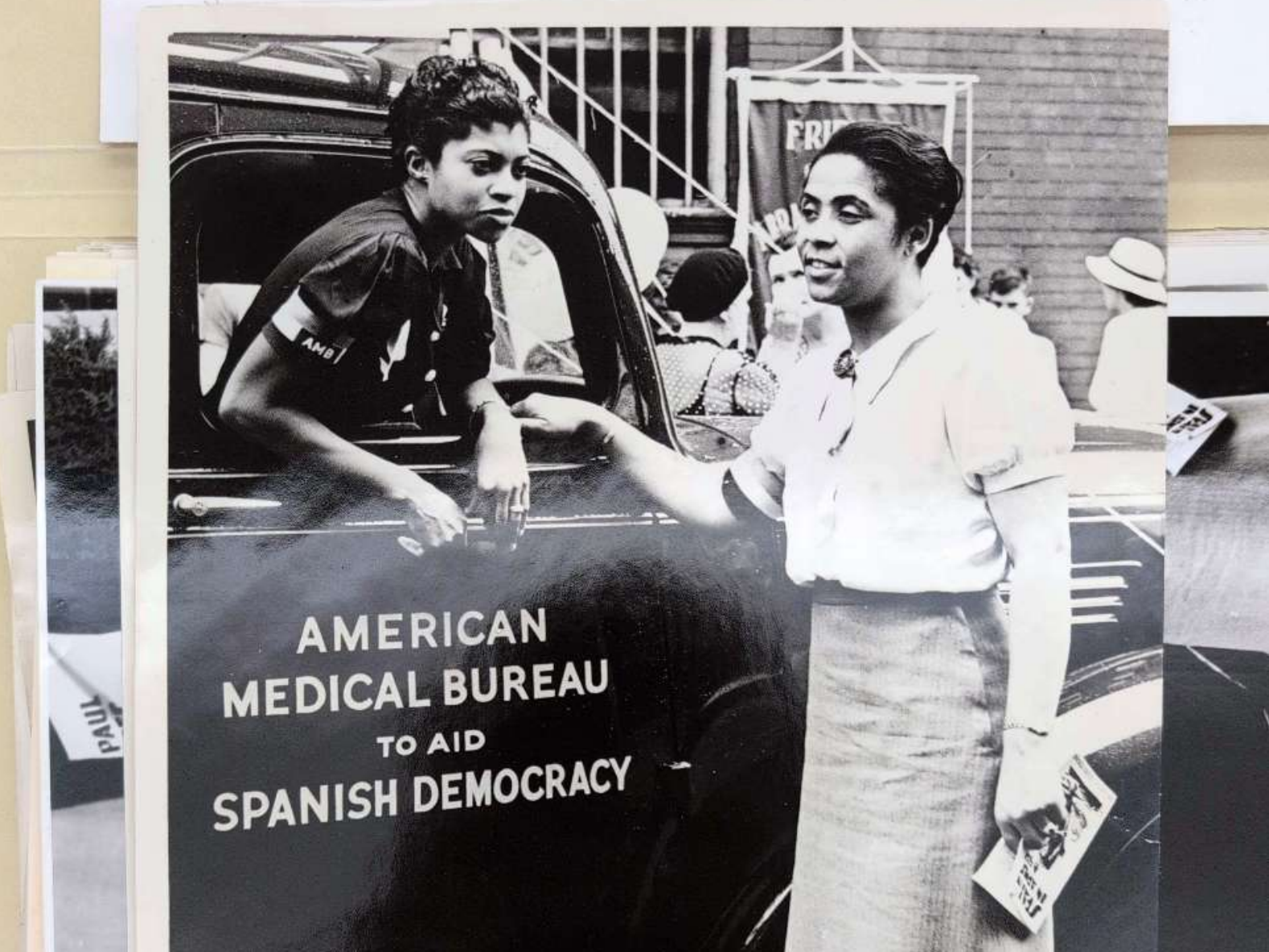
Mid-century Black anti-fascists are remembered for their strong solidarity with the Spanish Republic during the Civil War in which many volunteered in the international brigades and provided aid. These activities created enduring myths, icons and inspirational histories that continue to resonate today. US Black anti-fascist Internationalism remains a rich site for historical recovery with many protagonists and political initiatives waiting to provide new lessons, imaginaries and inspiration for contemporary anti-fascists.
One such icon that emerged from this period is Salaria Kea, the Black nurse that treated fighters for the Spanish Republic on the frontline. The famous portrait of Kea where she is dressed in her uniform looking defiant has become representative and symbolic of Black defiance and resistance against Fascism. However, it is one of Kea’s comrades, Thyra J. Edwards, that I wish to bring attention to. Alongside Kea, and others, Edwards was a key organiser of the Negro Committee to Aid Spanish Democracy’s ‘American Relief Ship for Spain’ drive to raise funds to provide an ambulance for the Republican’s struggle against General Franco’s fascist insurgency. However, Edwards’ anti-fascism went further than mere resistance, her anti-fascism was one of interracial unity and world building.
Born in 1897, in segregated Wharton, TX, Edwards was the grandchild of runaway slaves. She was socialised in a family strongly active in social reform, particularly on racial issues. Like most Black Americans, Edwards felt the effects of US racial relations from a young age. Despite growing up with a White best friend, Edwards attended a segregated high school and recalls how they could only enjoy their friendship in certain, private, spaces. This experienced shaped Edwards’ early understanding of racial relations and led her to believe that racial relations are learnt and spatially shaped.
Upon graduating high school Edwards followed the family tradition of social reform and joined the Houston chapter of the NAACP in 1918. The following year she began her lifelong career as a social worker. During this period, social work(ers) was segregated, and Black social workers were encouraged to work exclusively with Black Americans and communities. Among the first of many instances in her life, Edwards went against the grain and worked with both Black and White Americans and in Black and White communities. Setting her sights towards systemic changes, in 1924 Edwards co-founded Gary’s Interracial Commission in Gary, IN.

In 1931, Edwards moved to Chicago which propelled her political work on the national and international stage. She quickly became known as a prominent Black writer regularly publishing articles for prominent Black periodicals such as The Chicago Defender and The Crisis. It was also a time of great political education for Edwards. Funded primarily through her journalism, during the 1930s she embarked on several sojourns to Europe that took her to the Soviet Union, Nordics, Austria, Nazi German, France, Spain and England.
These trips were formative in Edwards’ racial and anti-fascist politics, not only did she experience fascism and Nazism firsthand, but she also experienced, for the first time, moving in spaces that she felt were not defined by race. Her time in the Soviet Union, in 1934, was a particularly pertinent experience where she left feeling impressed by the lack of racial prejudice against her.1 Edwards’ time in the Soviet Union was formative in that it demonstrated to her that racial equity was possible and that socialism provided a better environment for nurturing these relations.
Conversely, her experience in Nazi German shortly after her time in the Soviet Union exposed Edwards to Nazi racial politics. In face of entering Nazi Germany, Edwards’ remained her defiant and optimistic self. Her biography, Gregg Andrews recounts, [a]fter stopping at several houses in search of lodging [in Oberammergau], she at last found a family willing to let her stay with them. “Don’t you know that Hitler doesn’t want Negroes in Deutschland?” the father warned Edwards. “Aren’t you afraid to travel in Germany?” She replied that as an American Negro, she was accustomed to being hated. She expressed faith that since Hitler’s “Negro-phobia” was a “new epidemic” in Germany, not everybody would suffer from the disease.”2 Despite this optimism, Edwards did experience racism in Nazi Germany while qualifying it with the admission that it was not to the same extent as she experiences in the US – perhaps pointing to her theory that racial prejudice is a learnt behaviour.
Back in the US, Edwards political activity had a strong focus on interracial solidarities, building socialism and anti-fascism. In Chicago she continued her social work by advocating for improving and desegregating housing and education. She helped organised and propagated for equitable labour relations with organisations such as the Brotherhood of Sleeping Car Porters and the International Ladies’ Garment Workers’ Union. In 1936, she was a founding member of the National Negro Congress.

Her experience in Nazi Germany and the rally of Black Internationalism in response to Fascist Italy’s invasion of Ethiopia in 1935, Edwards’ activities began to focus on anti-fascist internationalism and the protection and creation of anti-fascist spaces. As mentioned, she was a crucial member of the American Relief Ship for Spain. In October 1937, Edwards went to Spain working with children displaced because of the civil at a children’s housing whilst the fight between republican loyalists and Franco’s nationalists remained fierce.
Edwards remained steadfast in her loyalty to Spanish anti-fascist and internationalism until her untimely death in 1953. In 1940 she aided over 300 anti-fascist Spanish refugees create an equitable settlement in Chihuahuan, Mexico. Later, during the final months in her battle with cancer, Edwards helped establish the first Jewish childcare program in Rome for victims of the Holocaust. In our current political climate in which xenophobia, racism and fascism is on the rise across the West, Edwards’ life and activities provide needed guidance, wisdom and clarity. Edwards stressed the need for stronger interracial social relations through interracial struggle and building equitable interracial relations. She understood that it is important to build and preserve inclusive spaces that nurture equitable relations. She did this whilst acknowledging the need to aid and support direct confrontation with organised fascist entities. Edwards developed her race and anti-fascist politics nearly a decade ago but her strategy remains as pertinent now as it then.
- Gregg Andrews, Thyra J. Edwards: Black Activist in the Global Freedom Struggle (University of Missouri Press, 2014), 54. ↩︎
- Andrews, Thyra J. Edwards, 65. ↩︎
To cite this article:
Shane Little, ‘Remembering Thyra J. Edwards: Anti-fascism, Race, Internationalism and World Building,’ The Helsinki Notebooks, Vol.2, No. 1 (1 October 2025).
Remembering Thyra J. Edwards: Anti-fascism, Race, Internationalism and World Building © 2025 by Shane Little is licensed under CC BY-NC-ND 4.0



Leave a Reply